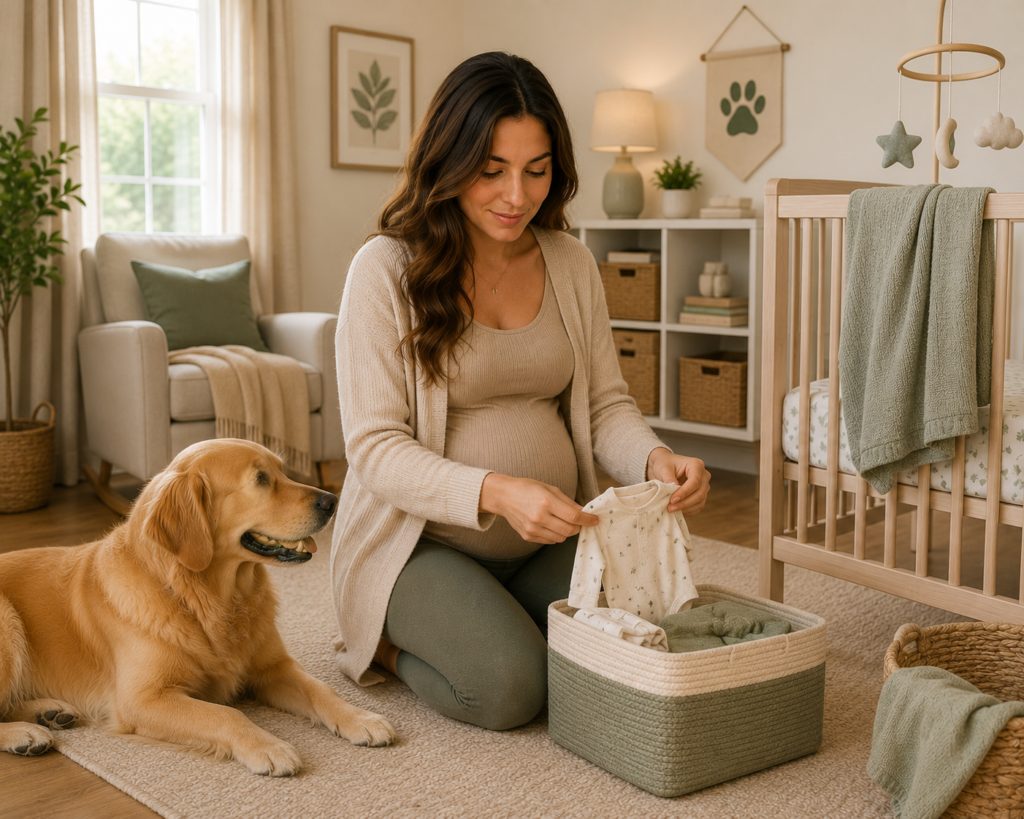

Your dog’s been unusually clingy lately, following you room to room in a way that’s new.
It’s not some mystical sixth sense — it’s scent, movement, and energy shifting under real hormonal changes, and dogs are simply good at noticing that kind of thing.
Why it’s mostly about scent and behavior, not instinct
A dog’s sense of smell in particular is remarkably sensitive to shifts in hormone levels — and it’s a genuinely powerful sense to begin with. Dogs have roughly 60 times more scent receptors than people do, enough to distinguish tens of thousands of individual smells, according to Dr. Ann Hohenhaus, a senior veterinarian at New York’s Animal Medical Center. That’s a big part of why so many pregnant pet owners report their dog acting differently well before there’s any visible sign of pregnancy. Increased clinginess, a bit more watchfulness, or wanting to be physically closer than usual are the most commonly reported changes, and they tend to track loosely with how significant your own hormonal and physical shifts have been.
Source: the American Kennel Club’s rundown of what’s known (and what’s still anecdotal) about whether dogs can sense pregnancy.
A Little Support for Every Stage
Helpful checklists, guides, and resources to make each stage a little easier.
How cats tend to show this differently
Cats tend to show this differently, if at all — sometimes more affectionate, sometimes more withdrawn, with less consistency across individual cats than the pattern dogs tend to show. This isn’t a reliable pregnancy indicator in either direction; plenty of pets show no noticeable change at all, and that’s just as normal.
What actually matters practically
If your pet’s behavior shift includes more neediness, a few concrete things help more than reassurance alone: keep departures and returns low-key rather than making a big fuss of them, since a calm goodbye and a calm hello teach a dog that your leaving isn’t a big event; stick to consistent feeding and walk times even when your own schedule is unpredictable; and try not to give in every time clingy behavior escalates into whining or pawing, since that can accidentally reward the exact behavior you’re hoping settles down. If what you’re seeing goes beyond clinginess — pacing, loss of appetite, destructive chewing, or panting with no clear cause — that’s worth a conversation with your vet or a certified dog behaviorist rather than something to wait out on your own.
Where this lands: yes, your pet may well be picking up on something real, through scent and behavior cues rather than anything mysterious. It’s a genuine, explainable phenomenon — just not a reason to change how you’re already handling routine and reassurance.
A cat’s version of this kind of misread behavior shows up too, often mistaken for jealousy once the baby’s actually here — here’s what’s really going on.
We'd love to
hear from you.
Have a question, a tricky moment you're navigating, or a story worth sharing? This is a two-way street — we're always listening.
💌 Get in Touch