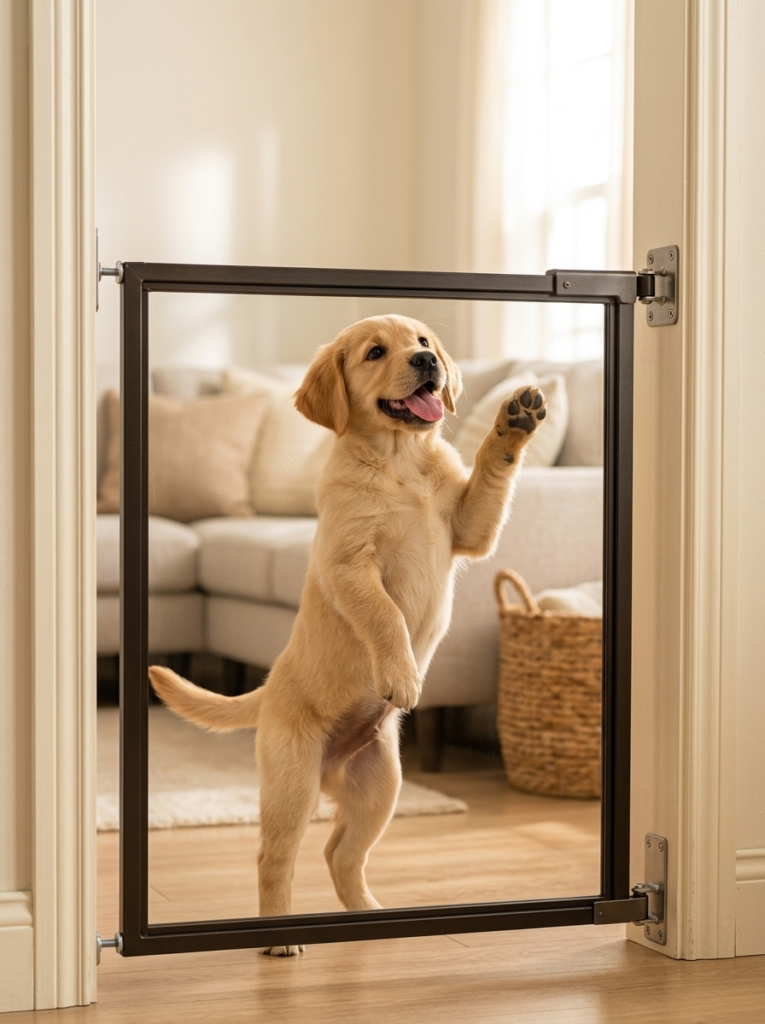
You picked out a baby gate for the nursery doorway. Your dog leans on it once, and it swings open like it was never there.
Not every baby gate is built for a dog’s weight — the real difference is hardware-mounted versus pressure-mounted, and it matters more than the label on the box.
Hardware-mounted vs. pressure-mounted
Hardware-mounted gates, screwed directly into the wall or door frame, hold up to a dog’s weight and persistence in a way pressure-mounted ones generally don’t. The tradeoff is installation — hardware-mounted gates leave small holes in your wall or frame, and they’re not something you casually move from doorway to doorway the way a pressure-mounted one is.
A Little Support for Every Stage
Helpful checklists, guides, and resources to make each stage a little easier.
When pressure-mounted is genuinely fine
For smaller dogs or ones who show no interest in testing the boundary, a pressure-mounted gate is often perfectly adequate, and the easier installation is a real advantage. The determining factor isn’t really the gate at all — it’s your specific dog’s size and their tendency to push against things they want past.
A reasonable way to test the waters first
If you’re not sure which category your dog falls into, a low-cost pressure-mounted gate is a reasonable way to find out before committing to a hardware installation — if it holds up fine over a few weeks, you likely didn’t need anything more. If it doesn’t, you’ve learned something useful before the actual boundary matters most.
Where this lands: match the gate type to your dog’s actual size and persistence, not just to what’s marketed as a “baby gate.” A hardware-mounted option costs more effort to install but won’t give way at the moment it matters.
A gate is one piece of the boundary-setting puzzle — here’s the rest of what actually needs to change before the baby arrives.
If the nesting urge has you deep-cleaning in the meantime, here’s how to do that safely with a dog around.
And once the nursery’s actually running, here’s how to get your dog used to its new sounds.