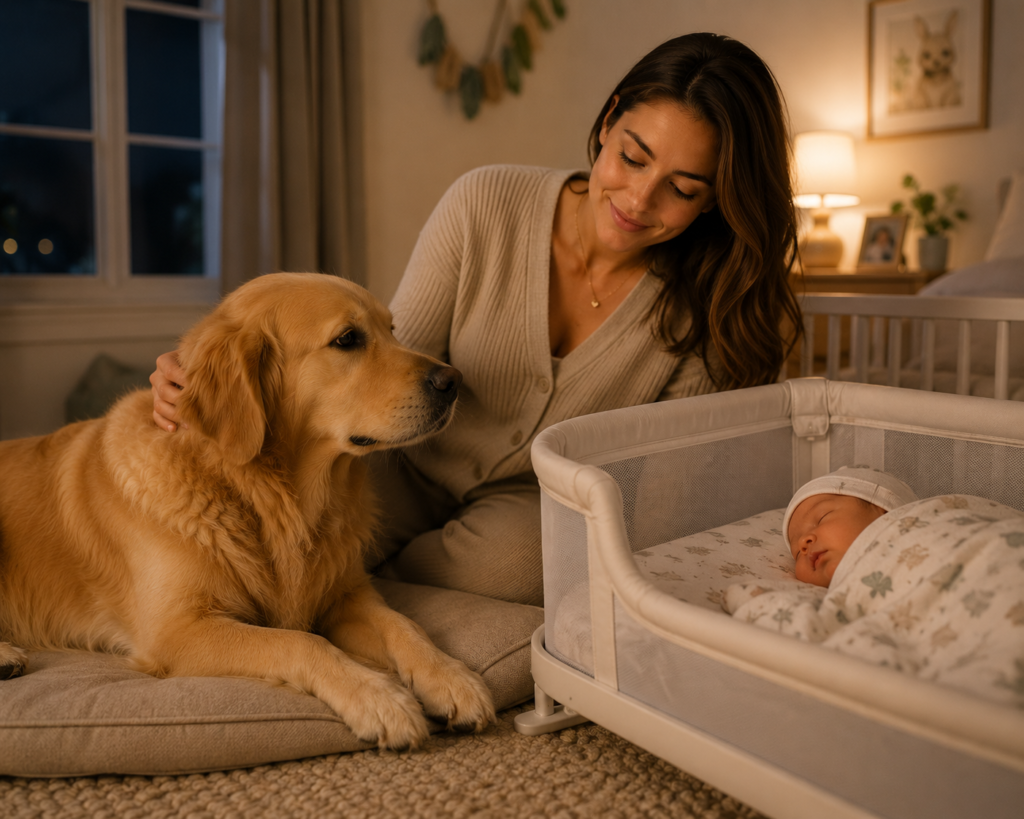
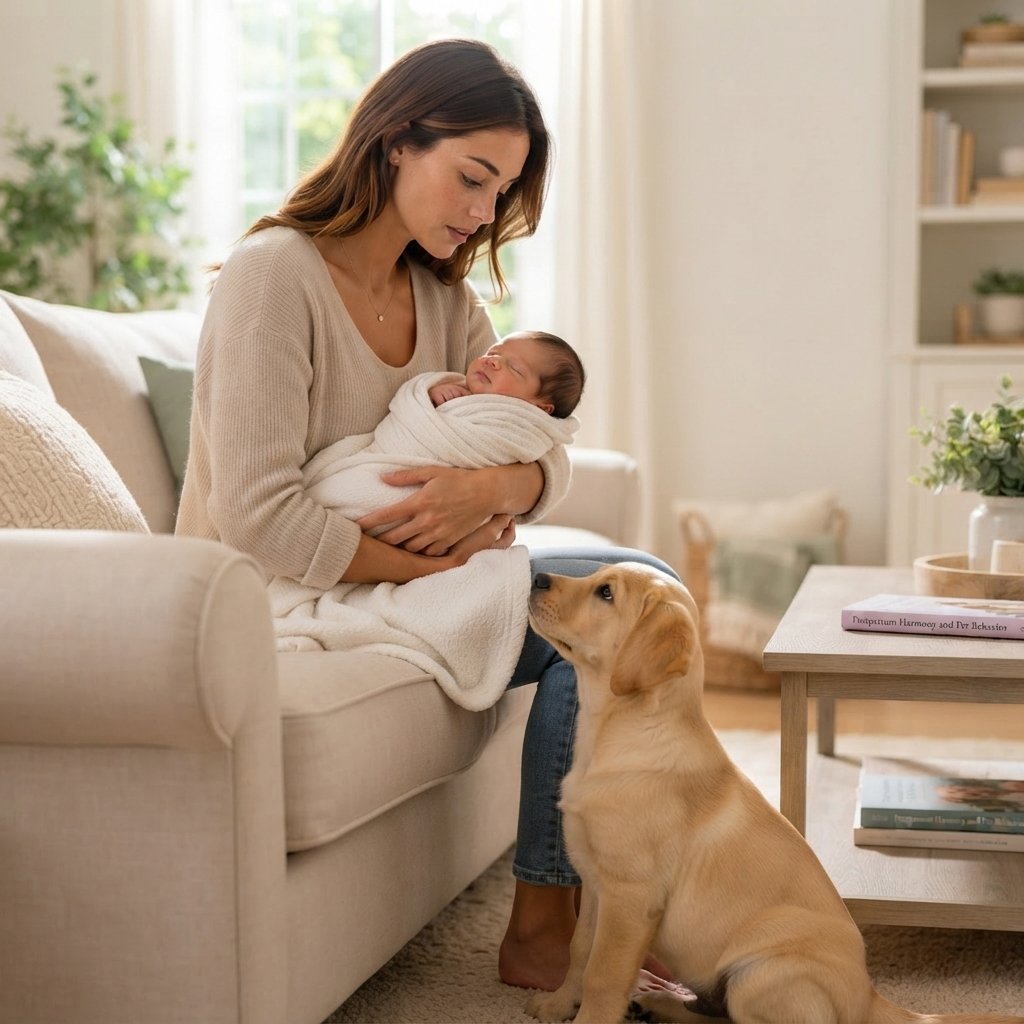
Your dog isn’t guarding the baby.
They’re responding to you — your scent, your sleep, your whole shifted state — and that’s a much simpler thing to settle.
Your dog’s been unusually watchful since you brought the baby home — sticking closer, more alert to visitors than usual.
Why “protective” isn’t quite the full picture
Increased watchfulness and sticking close to you specifically are often more about your dog responding to your own state — more tired, more emotional, home more than usual — than about a specific guarding instinct toward the baby. The behavior looks similar from the outside, but the underlying driver is more about you than about assessing the baby as something to defend.
There’s a real mechanism behind this, not just a general impression. A 2022 study out of Queen’s University Belfast found dogs could pick out a person’s sweat and breath samples taken during a stressful task from that same person’s calm-state samples with close to 94% accuracy — meaning a dog’s nose can detect the chemical shift that comes with a stress response, well before anything shows on your face. Postpartum hormone swings — a sharp drop in estrogen and progesterone right after birth, alongside disrupted cortisol and sleep — change your body’s chemistry in a real, physical way, and your dog is very likely picking some of that up directly, not reading your mood off your expression the way a person would.
If you want to know more: the Queen’s University Belfast study on dogs detecting human stress odor was published in PLOS ONE and covered in detail by ScienceDaily.
When this is genuinely fine, and common
Mild increased watchfulness, wanting to be nearby more than usual, briefly checking in when someone new enters the house — all of this is a normal adjustment response to a household that’s genuinely different right now, not a behavior that needs correcting.
A Little Support for Every Stage
Helpful checklists, guides, and resources to make each stage a little easier.
When it’s worth a closer look
Growling, stiffening, or overt guarding behavior directed at family members or regular visitors is a different category entirely, and worth addressing with a trainer regardless of how sympathetically it might read as “protecting the baby.” Genuine resource-guarding-style behavior toward people isn’t something to encourage even when the underlying instinct feels understandable.
What actually helps with the mild, normal version
Consistent routine, calm reassurance, and not making a big deal out of the watchfulness tends to help it settle as your own recovery progresses and the household finds a new rhythm. This is very similar to the general stress-mirroring pattern seen in other stressful stretches — the fix is largely the same.
Where this lands: your dog is very likely responding to the whole shifted household, including your own changes, more than specifically “protecting” the baby in a deliberate sense — and for most dogs, this settles on its own as things stabilize.
We'd love to
hear from you.
Have a question, a tricky moment you're navigating, or a story worth sharing? This is a two-way street — we're always listening.
💌 Get in Touch