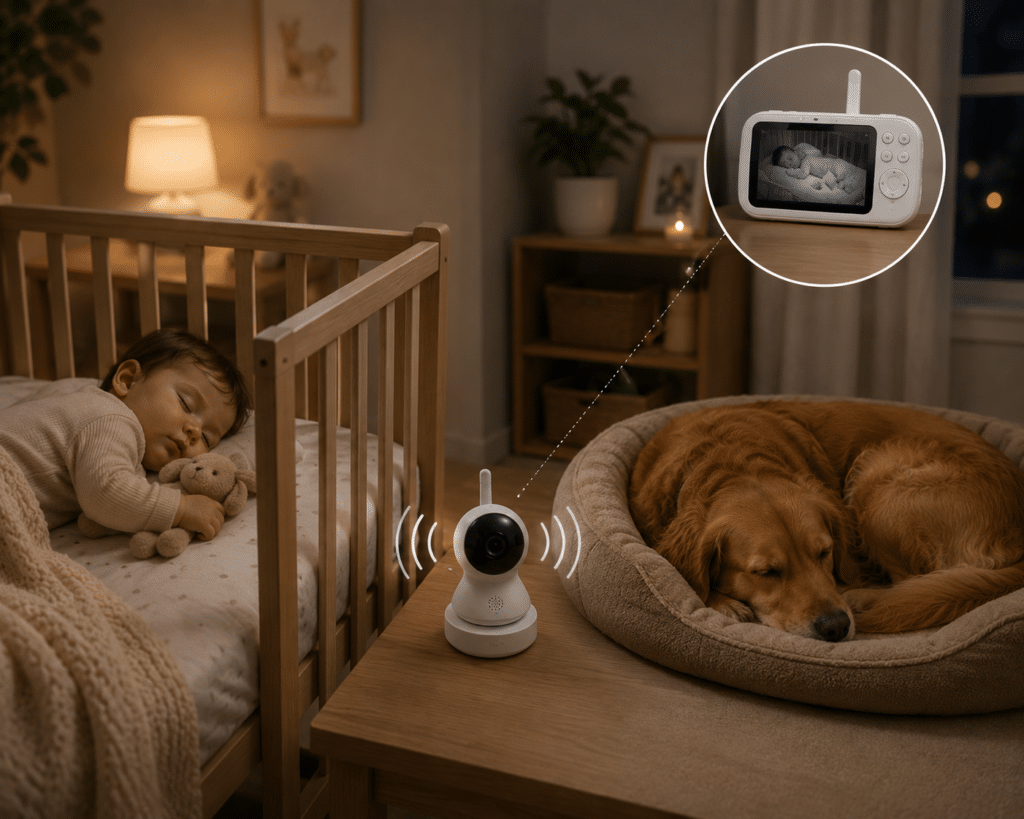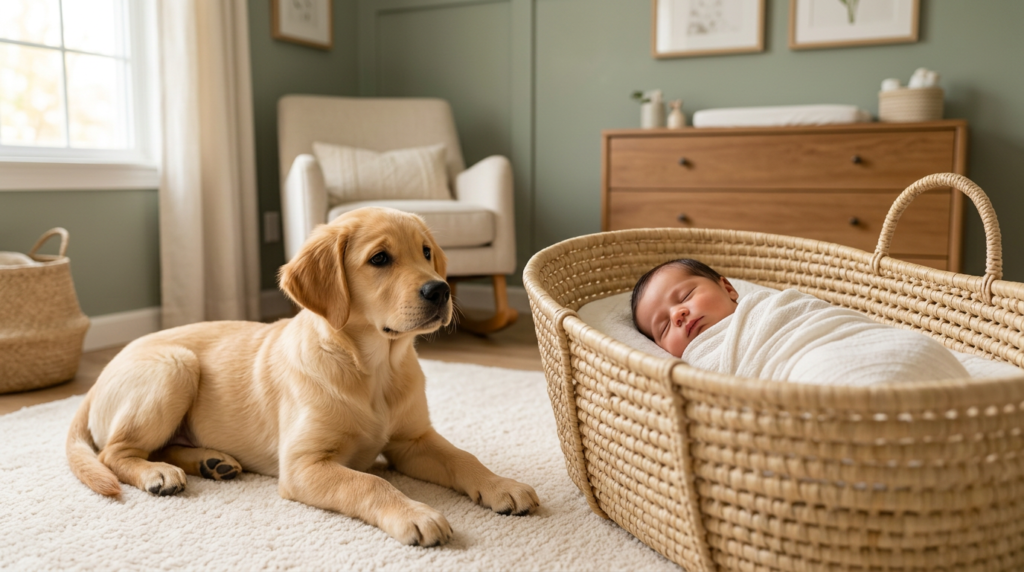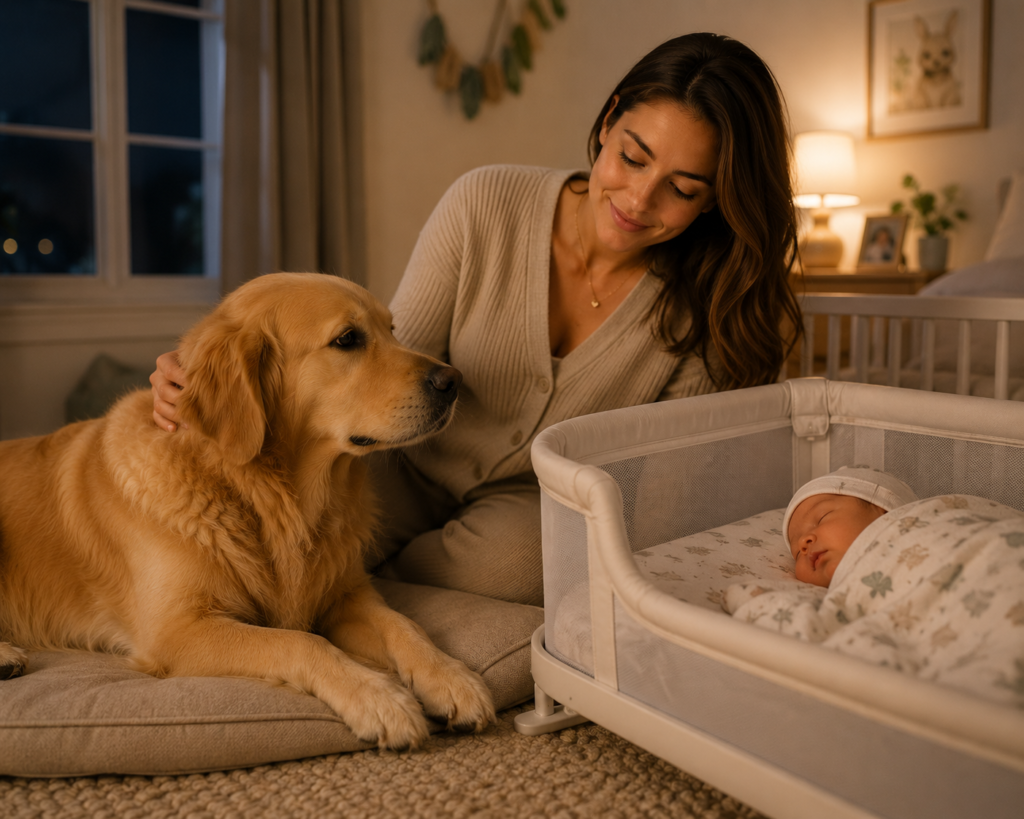
Your dog can sleep in the same room as your newborn.
What they can’t share is the bed or the bassinet — everything else can stay exactly as it is.
Before the details:
- You don’t need to move your dog out of the bedroom the night the baby comes home.
- Most of what helps is setup and a few weeks of gentle practice, not big changes.
- One rule never bends, and it’s at the end.
What’s in this guide
- Can my dog sleep in the same room as my newborn?
- Why “the room” and “the bed” are different questions
- Crate, bed or gate: picking the setup
- If your dog currently sleeps in your bed
- Night feeds with a dog in the room
- What to watch for around the crib
- If your dog is a light sleeper
- How long until everyone settles?
- The one rule that doesn’t change
Can my dog sleep in the same room as my newborn?
Yes. Your dog can sleep in the room, on their own bed or in their crate; what has to stay clear is your baby’s sleep space itself.
The American Academy of Pediatrics is specific about why: their 2022 policy statement advises that no pillows, sheets, blankets, pets, or other soft items that could obstruct breathing or cause overheating belong in an infant’s sleep space. That’s a rule about the crib or bassinet itself, not about your dog being in the room. Room-sharing is something the AAP actually recommends, tied to a meaningfully lower SIDS risk — and your dog on the floor, in that same room, isn’t something the AAP weighs in on directly. That part is professional and veterinary consensus, not an official guideline, and a reasonable one.
If you want to know more, the AAP’s full 2022 safe sleep statement is linked above — it’s the source behind both the soft-items rule and the roughly 50% lower SIDS risk credited to room-sharing.
Why “the room” and “the bed” are different questions
It’s an easy distinction to lose in casual conversation. Someone mentions their dog “sleeps with the baby” and it’s unclear whether they mean the same room or the same surface, and those are genuinely different situations with different guidance behind them. Being precise about which one you mean, both to yourself and to anyone giving you advice, avoids a lot of unnecessary confusion. It also explains why you’ll hear such different answers to what sounds like the same question.
Crate, bed or gate: picking the setup
There’s no single right arrangement, and the best one is usually whatever your dog already knows. A dog who’s comfortable in a crate can sleep in it in your room with the door closed overnight, which gives a clear boundary and stops any wandering over to the bassinet in the dark. A dog bed works well for a calm sleeper, placed a comfortable distance from where your baby sleeps and rewarded as their spot. If you’d rather your dog sleep just outside, a gate across the doorway lets them still see and hear you. Whichever you choose, avoid introducing a brand-new crate in the same week the baby arrives — give it time to become familiar first.
If your dog currently sleeps in your bed
The fix isn’t banishing them to another room the night the baby arrives — that kind of sudden change tends to create more stress than it solves. A dog bed or crate in the room, introduced over real weeks rather than days, with a few short sessions rewarding your dog for settling there, turns it into somewhere they choose rather than somewhere they’re sent. Moving the bed a little closer to its final spot every few days works better than placing it there on day one and hoping. No spare room? The same principle works with a spot on the far side of a shared room — what matters is the consistency, not the square footage.
A Little Support for Every Stage
Helpful checklists, guides, and resources to make each stage a little easier.
Night feeds with a dog in the room
Your dog will probably wake when you do, at least for the first few nights. Keep the lights low and the routine the same each time, and quietly reward your dog for staying on their bed while you feed. If they get up and hover near you or the bassinet, calmly send them back to their spot rather than turning it into a bigger moment at 3am. Some families find it easiest for one partner to handle the dog during night feeds, so the feeding parent can stay focused on the baby.
What to watch for around the crib
Some dogs treat a crib or bassinet as a new piece of furniture worth guarding — hovering near it, stiffening, reluctant to move away. That’s worth a conversation with your vet or a trainer if you notice it, rather than assuming it’ll pass. It’s different from ordinary curiosity, which usually looks like a quick sniff and then disinterest. Guarding tends to be more sustained and comes with visible tension in the dog’s body.
If your dog is a light sleeper
A dog who startles easily at night might do better a little further from the bassinet than a heavier sleeper would. Normal newborn noises — small cries, rustling, a monitor’s static — are more likely to wake them again and again. There’s no fixed distance that works for every dog. Watch your own dog over the first few nights and adjust the setup based on what you actually see.
How long until everyone settles?
There’s no fixed timeline, and the first few weeks are often a little bumpy for everyone, dog included. Most of the settling comes from the routine becoming predictable: same bed, same spot, same calm response at night. It’s worth asking your vet or a trainer for help if your dog still can’t settle at night after several weeks, stops eating, or keeps guarding the crib. Those are signs your dog needs a bit more support, not signs the arrangement has failed.
The one rule that doesn’t change
No unsupervised time together, ever, regardless of how well things have been going. Any dog can react to a sudden noise in ways that are hard to predict from a sound sleep — that’s not a reflection on your dog, it’s simply the rule that doesn’t bend. It applies to naps, to a quick trip to another room “just for a minute,” and to months in, once everything has clearly settled. If you need to step out, your dog steps out too, or the door closes between them.
Where this lands: your dog can share the room, not the bed — a familiar setup, a calm night routine, and one unbending rule are what make it work.
If your dog runs anxious at night, this trick might help.
Thinking beyond the bedroom to the rest of the house? Here’s how to handle shared nap spaces safely, and here’s the honest answer on licking, if that’s the next question on your mind.