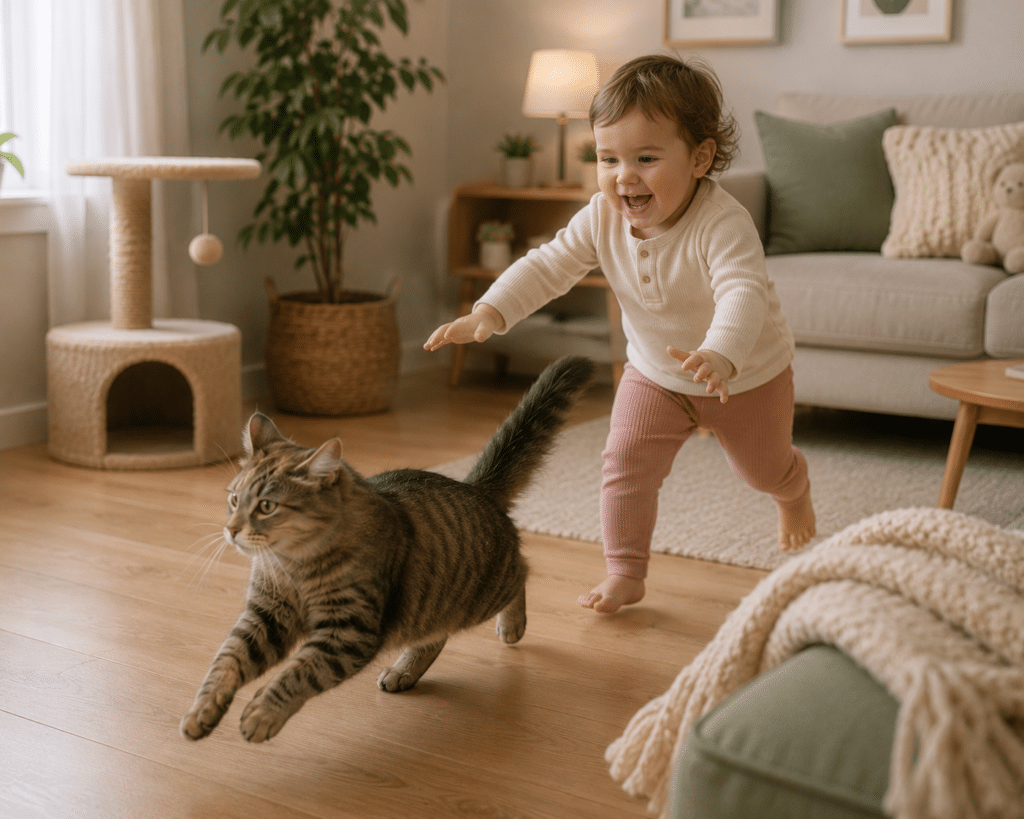
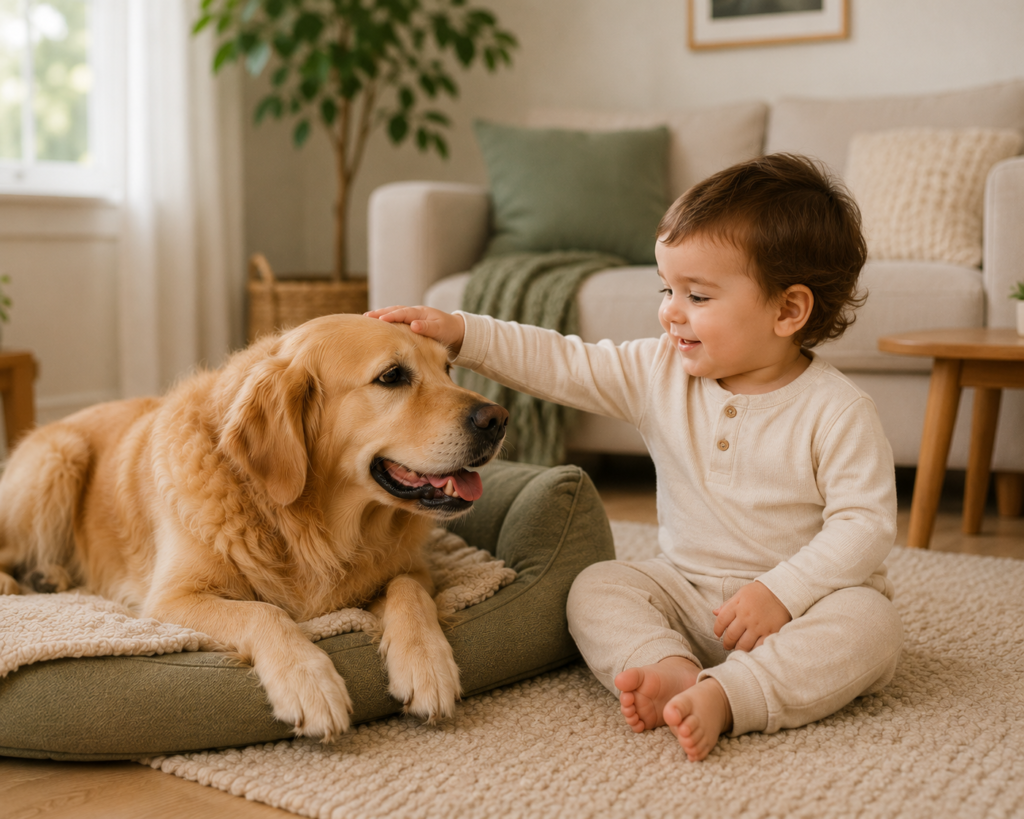
Your toddler reaches for the dog’s tail for the third time today.
Most advice about toddlers and dogs only manages the dog.
This is the other half — the part where your toddler learns a few rules too.
Give the dog a real safe zone
A crate, a gated room, even just a bed in a spot your toddler knows is off-limits, stocked with something good, so retreating there is a reward, not a timeout. The stocking part matters more than it might seem — a safe zone that’s just an empty corner doesn’t give your dog much reason to actually use it, while one with a favorite chew or a stuffed Kong makes it somewhere they choose to go, not somewhere they’re sent.
Two phrases toddlers actually remember
“Soft touch, not too much,” and “dog with a bone, leave him alone.” These work specifically because they’re short, rhyme, and give a toddler something concrete to repeat back, rather than an abstract instruction like “be gentle” that doesn’t translate into an actual physical action. Repeating them consistently, in the same words every time, builds the association faster than varying the phrasing does.
Teach the early warning signs, not just the growl
A lip lick, a freeze, a turned head — long before a growl, narrating them out loud so the habit builds for both of you. “Look, she’s licking her lips, that means she needs a little space” said calmly and consistently, every time you notice it, slowly builds your toddler’s own ability to notice these signs independently over time, even though that takes far longer than a single conversation.
A Little Support for Every Stage
Helpful checklists, guides, and resources to make each stage a little easier.
Give the dog dedicated time away from the chaos
Five minutes of one-on-one time when you can manage it — a short walk, a quiet training session, anything that’s just the dog and an adult, no toddler underfoot. This isn’t just kindness for its own sake; a dog who gets some predictable relief from constant toddler attention generally has more patience for the moments they are together.
Let your toddler help in small, structured ways
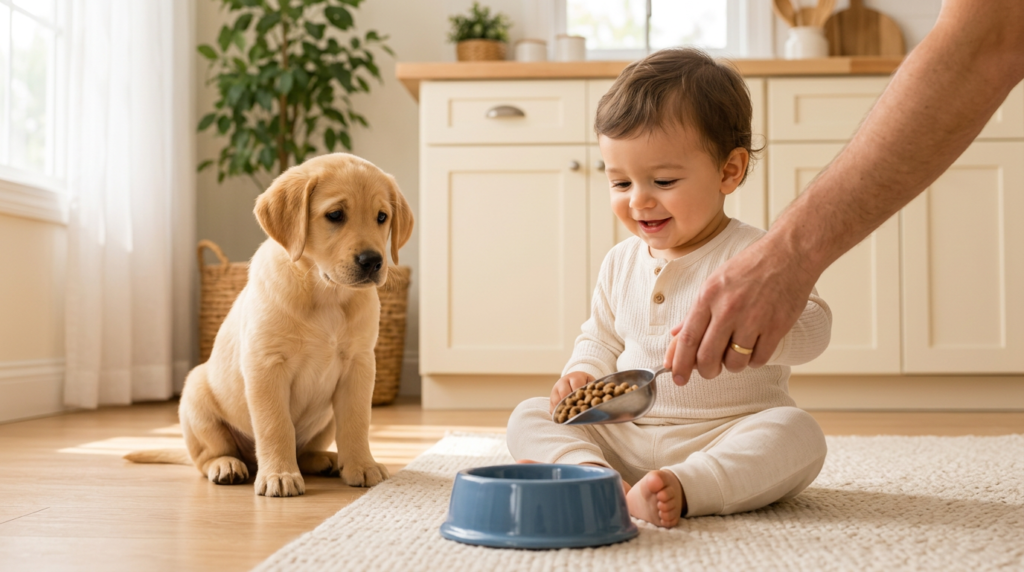
Holding the scoop at feeding time, being the one who says “okay” before the bowl goes down — small, structured involvement gives your toddler a positive way to be part of the dog’s care, rather than experiencing the relationship as a constant string of no’s. This also reinforces the “dog with a bone, leave him alone” rule in a way that sticks better than a warning ever does, since your toddler is actively participating in respecting that boundary rather than just being told about it.
What this looks like when it’s working
Over weeks, not days, you’ll likely notice your toddler starting to narrate the warning signs themselves — “dog’s licking, leave alone” — before you’ve had to say anything. That’s the actual goal: not perfect behavior on day one, but a toddler who’s slowly building real awareness of another creature’s signals, which is a skill that extends well beyond just this one dog.
What to do if progress feels slow
Toddlers are inconsistent by nature, and a good day followed by a rough one doesn’t mean the approach isn’t working — it means you’re teaching a skill to someone whose impulse control is still developing on its own separate timeline. Consistency in how you respond matters more than how quickly your toddler seems to be catching on.
Neither approach replaces supervision — a toddler and a dog still shouldn’t be left alone together, no matter how well either side is doing. But the version that actually builds toward less supervision over time is the one where the dog has a real say in it too.
Have a cat too? Here’s the cat-specific version of this same lesson.
We'd love to
hear from you.
Have a question, a tricky moment you're navigating, or a story worth sharing? This is a two-way street — we're always listening.
💌 Get in Touch