
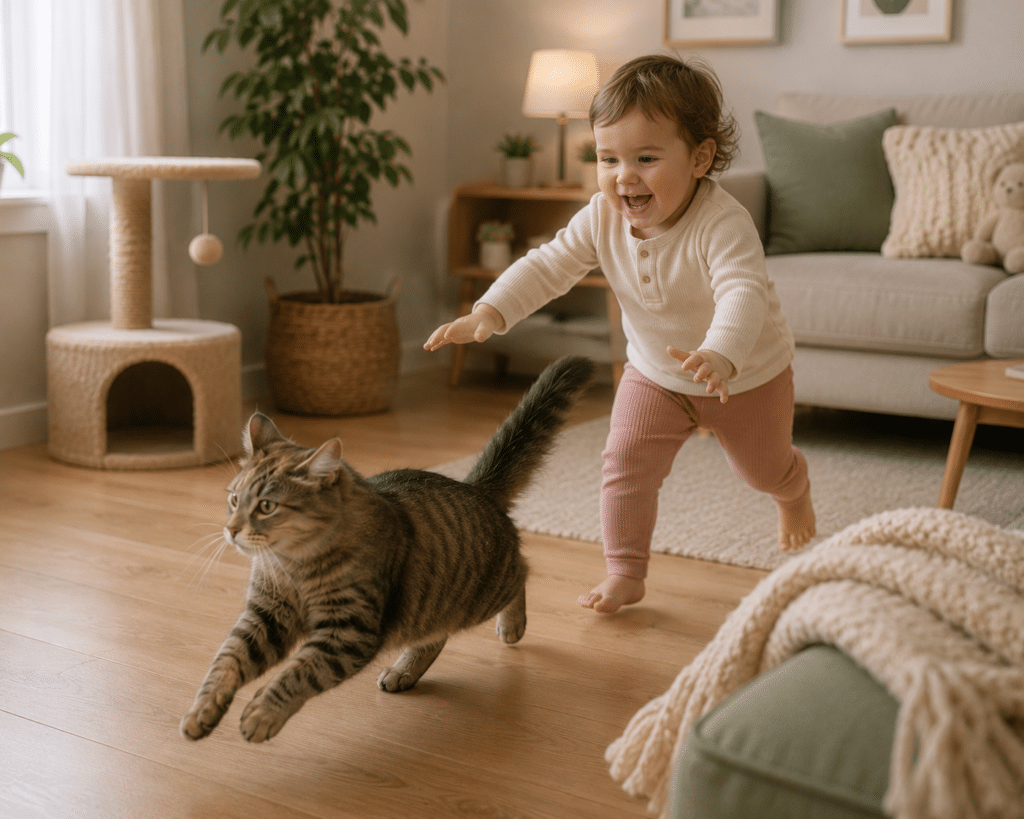
Your toddler takes off after the cat again, giggling. The cat doesn’t giggle back — it just leaves.
Chasing a cat doesn’t end the way chasing a dog does.
Here’s what actually helps — for your toddler, and for the cat.
Making sure your cat always has somewhere to go
A high shelf, a cat tree, an open door to another room — so the chase has a natural, low-stress ending. This matters more with cats than dogs specifically because a cat’s stress response leans heavily toward escape rather than tolerance; a cat with no clear exit is far more likely to end up cornered and reactive than one who can simply leave the situation on their own terms.
A phrase short enough for a toddler to actually hold onto
“When the kitty walks away, she doesn’t want to play” — repeated consistently, calmly, every time it applies, rather than only when the chasing is already in full swing. Saying it as a simple observation, not a scolding, helps it land as information your toddler can use rather than a rule they’re being punished for breaking.
Redirecting the actual instinct, not suppressing it
A long-handled wand toy keeps the same chase-and-catch excitement while keeping hands and face out of swatting range. This works because it doesn’t ask your toddler to stop wanting to chase something — it just moves the object of the chase from the cat’s actual body to a toy your toddler controls, which satisfies the same underlying impulse without the risk.
A Little Support for Every Stage
Helpful checklists, guides, and resources to make each stage a little easier.
Making retreat spaces genuinely off-limits
Treat wherever the cat retreats to as fully off-limits, so it stays an actual safe space rather than just the next stop in the chase. This requires some consistency from the adults in the house too — if your toddler occasionally does get to follow the cat into that space, even once, it stops functioning as a reliable retreat.
The warning signs worth teaching yourself, then your toddler
Stiffening, flattened ears, or a hard-flicking tail are the signs that show up before a hiss, not just the hiss itself. Catching those early is what actually prevents the scratch. These are worth learning to spot yourself first — narrating them out loud when you see them (“look, her ears are back, she needs space”) slowly builds the same recognition in your toddler over time, the same way it does with a dog’s warning signs.
What if your cat doesn’t seem to have a clear favorite retreat
Some cats haven’t settled on one go-to spot, which makes this harder to rely on consistently. Setting up two or three genuinely appealing options — a shelf near a window, a covered bed in a quiet room — and seeing which one your cat gravitates toward gives them a real choice rather than assuming they’ll figure out an escape route on their own during an actual chase.
Why patience matters more here than with most toddler behaviors
This isn’t a behavior that responds well to a single firm conversation, since it’s rooted in a developmental impulse rather than a choice your toddler is consciously making. Expect this to take real weeks of consistent redirection rather than looking for a fast fix, and treat any single lapse as normal rather than a sign nothing’s working.
Have a dog too? Here’s the dog-specific version of this same lesson.
We'd love to
hear from you.
Have a question, a tricky moment you're navigating, or a story worth sharing? This is a two-way street — we're always listening.
💌 Get in Touch