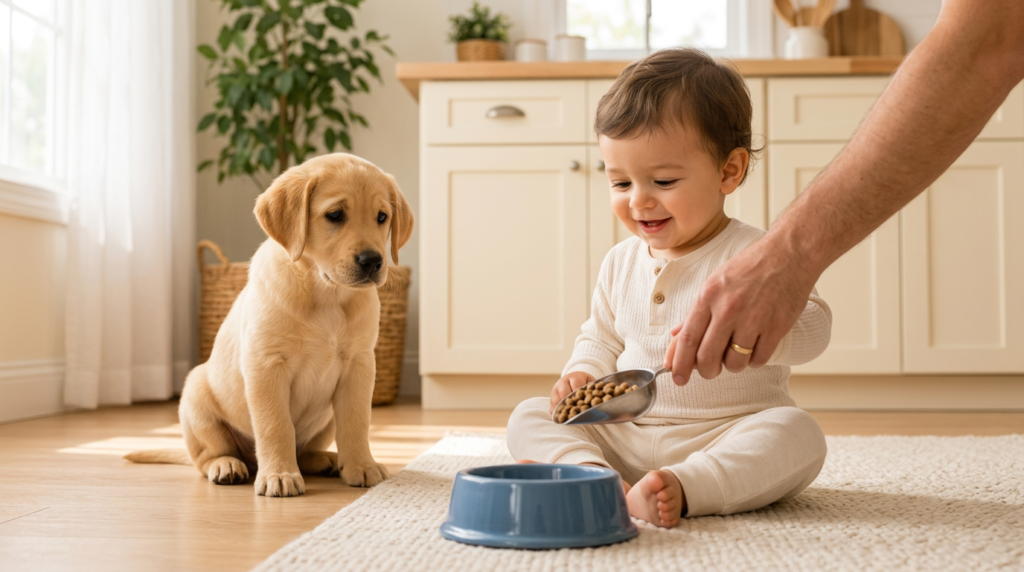
Your toddler wants to help at feeding time, scoop in hand, standing right next to an excited dog.
There’s no single age where a toddler becomes ready to help feed the dog.
But there is a clear line on the food itself — and plenty of ways to make your toddler part of feeding time long before they cross it.
Before the details:
- Wanting to help is a lovely instinct, and worth encouraging rather than shutting down.
- The guidance here is about germs and one excited moment at the bowl — not about your dog being untrustworthy.
- Your toddler can have a real job at mealtime starting today.
What’s in this guide
- When can a toddler touch the dog’s food?
- Feeding-time jobs your toddler can do right now
- Why the bowl-down moment stays an adult’s job
- When your toddler feeds the dog from the high chair
- What if my toddler eats dog food?
- Signs your child is ready for the next stage
- When your toddler tries to rush ahead
When can a toddler touch the dog’s food?
The CDC’s advice is that children five and under shouldn’t touch or eat pet food, treats, or supplements, and that young kids are best kept away from the feeding area itself. The reason is germs, not your dog: dry pet food can carry bacteria like Salmonella, and young children are more likely to get very sick from foodborne germs than older kids and adults. So the hands-on parts — scooping kibble, holding treats, carrying the filled bowl — wait until around age six, with handwashing before and after every time. That still leaves your toddler a real role at mealtime, just one that keeps little hands off the food.
If you want to know more, the CDC’s tips on Salmonella and dry pet food cover the under-five guidance and the feeding-area advice: cdc.gov. Its pet food safety page covers the handwashing habits.
Feeding-time jobs your toddler can do right now
Your toddler can be the one who announces “dinner time!”, asks the dog for a “sit” from the doorway, or says the “okay” that lets the dog start eating — all from just outside the feeding spot. They can also choose which toy the dog gets once dinner is done, which gives them something to look forward to that has nothing to do with the bowl. These jobs feel genuinely important to a two- or three-year-old, because they are: your toddler is helping run the routine. Other dog-care tasks, like gentle brushing with you, can grow alongside these, with a handwash afterward.
Why the bowl-down moment stays an adult’s job
Even a well-behaved dog can get excited or protective the instant food actually appears, which is a different moment from the calm minutes before it. More dogs show some excitement or mild guarding right as the bowl touches the floor than at any other point in the routine, regardless of how gentle they normally are. That’s why the bowl itself stays in your hands, with your toddler watching from behind a gate or the doorway. Narrate the handoff — “you called him for dinner, now I’ll bring it to him” — and it reads as teamwork, not as being pushed aside.
A Little Support for Every Stage
Helpful checklists, guides, and resources to make each stage a little easier.
When your toddler feeds the dog from the high chair
This is one of the most common feeding questions parents have, and it usually starts by accident: a dropped cracker, a delighted giggle, and a dog who quickly learns where the snacks come from. The trouble isn’t the cracker, it’s what follows — a dog stationed under the high chair, nose close to little fingers, sometimes taking food straight from a hand. A calm fix is giving your dog their own spot during toddler meals, a mat or bed with a chew, or a gate between them. Wipe hands and faces after meals, and expect a few weeks of gentle reminders before the new routine sticks for both of them.
What if my toddler eats dog food?
A curious handful of kibble is a very common toddler moment, so try not to panic. Wipe out their mouth, wash their hands, and keep the food out of reach from then on. If you’re unsure what to do, or your child has diarrhea, fever, or stomach cramps in the days after, call your pediatrician — those are the usual signs of a Salmonella infection. It’s also a good reason to store the dog food in a closed container your toddler can’t open.
Signs your child is ready for the next stage
From around six, scooping and pouring can become your child’s job, with handwashing before and after. The bowl-down moment is a separate step: it usually stays with an adult until somewhere between ages five and nine, and even then with you standing close the first several times. Beyond age, a few signs matter more: whether your child can follow a one-step instruction while excited, whether they can wait their turn in other situations, and whether your dog is calm and predictable at mealtime specifically. A dog who gets very worked up around food — circling, whining, pushing toward the bowl — is a good reason to keep the adult-only stretch longer.
When your toddler tries to rush ahead
It’s common for an eager toddler to reach for the scoop or the bowl before it’s their turn, especially once they feel confident in their own jobs. A calm, consistent redirect — “the food is my job for now, the ‘okay’ is yours” — repeated as many times as it takes, works better than treating it as a rule they’re breaking on purpose. Toddlers test the edges of a routine because that’s how they learn where the edges are. Keeping your words the same every time helps the boundary feel predictable rather than personal.
Where this lands: your toddler doesn’t need to touch the food to be part of feeding time — give them the dinner call, the “okay,” and the after-dinner toy, and save the scoop for around age six.
This fits into the same stretch as teaching a toddler to respect the dog’s space — feeding time is one of the moments that rule is built for.
Feeding is one task among several your child can grow into. Here’s the fuller picture of dog chores at each age.