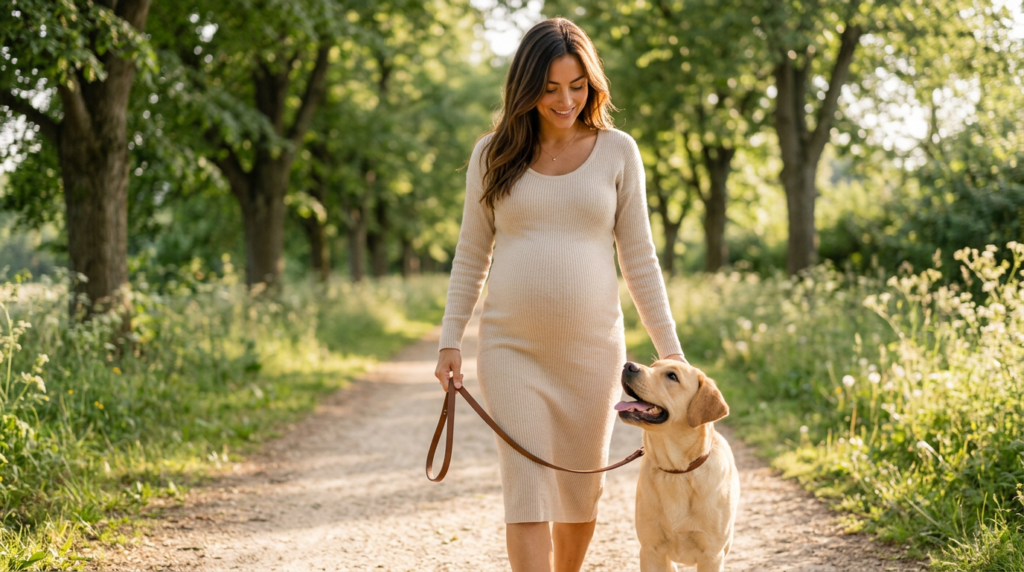
Doctors don’t tell you to stop walking in the third trimester.
They tell you to keep going — just shorter, flatter, and slower than before.
What’s actually happening in your body that affects this
Joints loosen as pregnancy progresses, thanks to a hormone called relaxin that prepares your body for delivery. That loosening affects balance in ways worth respecting, especially on uneven ground or with a dog prone to sudden pulling — a stable surface and a well-behaved leash habit both matter more now than they did earlier in pregnancy. Standing still for long stretches — waiting at a corner, chatting with a neighbor mid-walk — can also cause blood to pool in your legs, which is more of a third-trimester-specific thing to watch than the walking itself. This is why a slow, continuous walk is often more comfortable than one with a lot of stopping and starting.
Adjusting the route rather than cutting the walk
A shorter, flatter route beats no route at all — the same walk, just adjusted, keeps the routine intact for your dog while working within your own comfort. If your usual route has hills or uneven terrain, this is a reasonable stretch to trade it for something flatter, even temporarily. The goal is finding the version of the walk that still happens consistently, not the version that matches exactly what you were doing in month four.
Building in backup before you need it
Building in a backup person for high-energy days, before you actually need one, means your dog’s exercise doesn’t depend entirely on how you’re feeling that specific day. This matters more in the third trimester than earlier, simply because how you feel can shift day to day in ways that are harder to predict. Having a partner, neighbor, or dog walker already lined up — even if you rarely end up needing them — removes one more thing to figure out on a day you’re not up for it.
A Little Support for Every Stage
Helpful checklists, guides, and resources to make each stage a little easier.
Know your own real stop signals
Standard pregnancy guidance is clear on this regardless of the dog involved: stop and seek care for heavy bleeding, regular painful contractions, chest pain, trouble breathing, dizziness, fainting, a severe headache, or vision changes. None of that is walk-specific, but it’s exactly the list worth knowing before you’re out on a route with a leash in hand, further from home than you might be comfortable with if something felt off.
What if your dog is large or strong-pulling?
If your dog’s size or leash manners make balance a genuine concern rather than a minor one, this is a reasonable stretch to lean more heavily on a hands-free leash designed to distribute pull differently, or to shift more walks to a partner while you handle shorter, calmer outings yourself. None of this reflects poorly on your dog’s training — it’s simply matching the activity to where your balance actually is right now, which is a temporary state, not a permanent one.
What this means for your dog’s bond, specifically
A shorter, slower walk together still counts as together. The routine mattering more than the pace or distance is exactly the kind of thing dogs don’t measure the way people worry they might — a ten-minute walk at your side reads, to your dog, as fundamentally the same kind of event as a forty-minute one, just shorter. The consistency of it happening is what your dog is actually responding to.
Where this lands: walking remains genuinely good for you and your dog through the third trimester. What changes is the shape of it — shorter, flatter, with backup on hand — not whether it happens at all.
Walking is just one routine worth protecting before the baby arrives — here’s the fuller picture of what else is worth doing ahead of time.