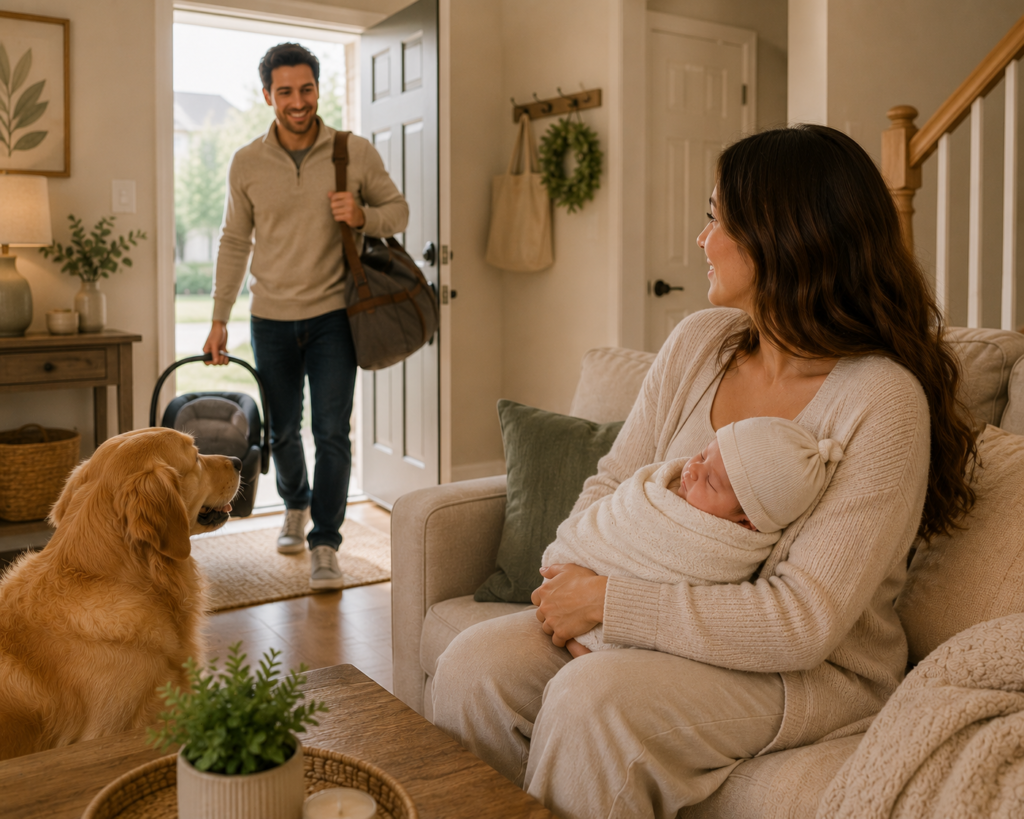
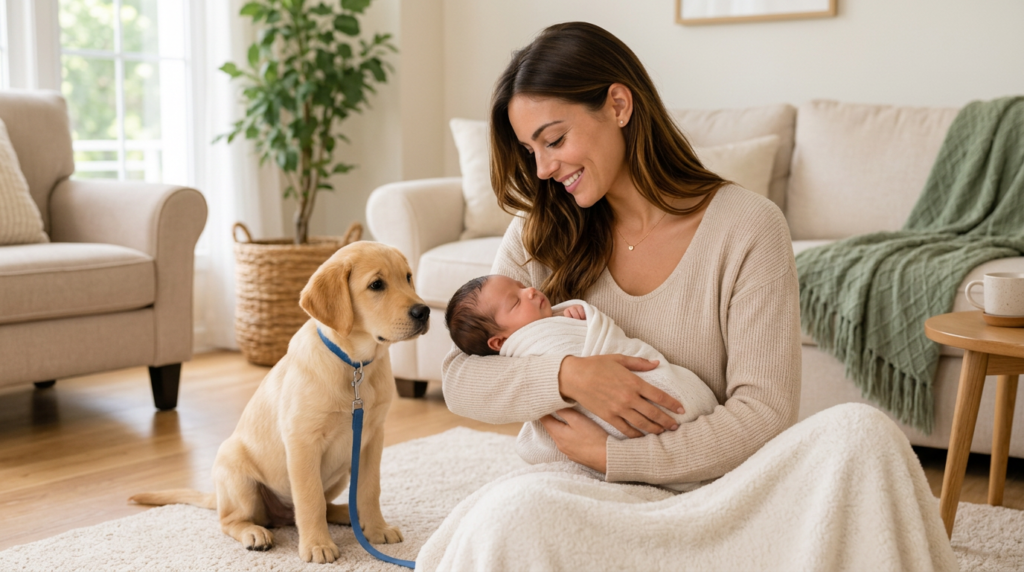
Guests coming to meet the baby is exciting for everyone except possibly your dog.
A new person at the door on a normal day is a lot. During the newborn weeks, it’s a lot on top of a lot.
Before the specifics:
- This isn’t about limiting who gets to visit. It’s about managing what’s already a genuinely full house for your dog.
- Withdrawal counts as a stress sign here too, not just obvious barking or jumping.
- None of this requires turning visits into a production. Small, consistent habits do most of the work.
What’s in this guide
- Tire your dog out beforehand
- Leash your dog before the door opens
- A retreat spot with something to do there
- Keep the routine intact
- Ask guests to match the energy you want
1. Tire your dog out before anyone arrives, if you can.
A walk or play session earlier in the day burns off the energy that often turns an exciting doorbell into jumping or barking. It’s not a guaranteed fix for every dog, especially an anxious one, but it genuinely helps the excitable ones more often than not. If a full walk isn’t realistic with a newborn in the house, even ten minutes of fetch in the yard or a short training session does a meaningful chunk of the same work.
2. Leash your dog before the door opens.
This gives you immediate control the moment guests walk in, rather than trying to catch up after your dog’s already at the door. It’s a management tool, not a statement about your dog’s usual behavior. If you have a partner or family member around, having them handle the leash while you’re occupied with the baby or a guest keeps the moment from falling entirely on one person.
A Little Support for Every Stage
Helpful checklists, guides, and resources to make each stage a little easier.
3. Give your dog a retreat spot with something to do there.
A crate, a mat, or a quiet corner, paired with a stuffed chew or a snuffle mat, gives your dog somewhere to go that isn’t just “away from the noise” but actually occupied and calming. Sniffing activities in particular have a real, measurable calming effect — a dog’s heart rate drops and their body shifts into a more settled state while they’re doing it.
Set this up before guests are due to arrive, not once things are already loud — a dog who’s already amped up takes longer to settle into a retreat spot than one who’s guided there while still relatively calm.
4. Keep as much of the actual routine intact as you can.
Feeding times, potty breaks, and at least part of the usual walk schedule staying consistent gives your dog something predictable in a week that’s otherwise full of new faces and new smells. It matters more right now than it would on an ordinary day, precisely because so much else has already changed. If visitors are coming through daily for a stretch, this consistency is doing more work than it might seem — it’s the one part of the day that still looks like the life your dog knew before.
5. Ask guests to match the energy you actually want.
A calm greeting from visitors, rather than an excited rush toward your dog, keeps the whole interaction lower-key. Most people are happy to tone it down for a few minutes once you ask, especially if you frame it simply — “he’s had a big week, if you could let him come to you that’d help” tends to land better than a longer explanation.
What withdrawal actually looks like, since it’s easy to miss
An overstimulated dog doesn’t always look agitated. Some dogs handle a full house by disappearing — spending more time under a bed, in another room, or simply not seeking out attention the way they normally would. This is just as real a stress response as barking or pacing, and it’s worth checking on a quiet dog during a busy stretch the same way you’d check on an obviously anxious one, since the quiet version is easier to overlook entirely.
If visitors are coming through for several days in a row
A single visit and a steady stream of them over a week ask different things of your dog. If you know you’re heading into several consecutive days of guests, it’s worth building in real downtime between visits — even an hour of just your household, no one new — rather than treating the whole stretch as one continuous event. Dogs recover from stimulation the same way people do, with actual rest, not just the absence of the specific stressor.
What this actually comes down to: Your dog isn’t failing at the newborn weeks — they’re managing a bigger stack of new things than usual, visitors included. A tired dog, a retreat spot, and a mostly-normal routine cover most of it.
Expecting a visit that brings its own dog or toddler along too? Here’s how to give a visiting pet the same thoughtful introduction yours got.
We'd love to
hear from you.
Have a question, a tricky moment you're navigating, or a story worth sharing? This is a two-way street — we're always listening.
💌 Get in Touch