There’s no proven formula for the first ten minutes.
There is strong agreement on what to avoid after them — and that part matters more.
Before you walk in:
- This isn’t about whether your dog can be trusted. Even the calmest dog gets a leash today.
- Nothing here requires equipment you don’t already have by the door.
- If it doesn’t go perfectly, that’s fine. You get more than one first ten minutes.
No controlled study has ever tested one specific introduction sequence against another — even VCA Animal Hospitals says outright that “there are many different theories and tactics.” What follows is strong, convergent agreement across vets, trainers, and animal hospitals, not a validated formula. It’s worth following unless your own vet says otherwise for your specific dog — and if your dog has any history of aggression, resource guarding, or high prey drive, talk to a certified veterinary behaviorist before today, not after.
What’s in this guide
- Exercise your dog before you leave
- Let your dog greet the humans first
- Leash your dog once they’ve calmed down
- Keep treats by the door
- One adult holds the baby, another holds the dog
- Let your dog sniff from a distance
- Reward calm, and don’t force anything else
1. Exercise your dog before you leave for the hospital, or beforehand if someone’s home.
A walk or a play session burns off the kind of pent-up energy that turns a greeting into jumping. This is the one step that has to happen before you’re already at the door, so plan it the day before if you can. If a full walk isn’t realistic that day — a partner’s already left, or your own schedule is unpredictable — even ten minutes of active play in the yard or a game of fetch down the hallway takes the edge off more than skipping this step entirely.
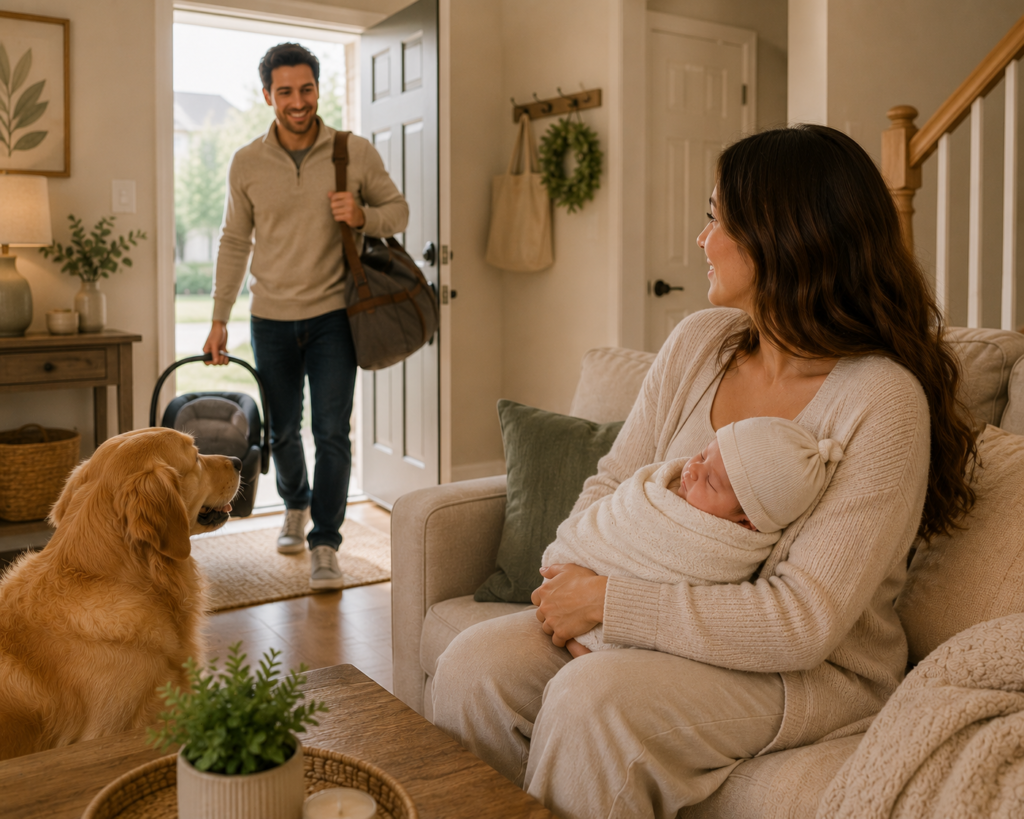
2. Let your dog greet the humans first — without the baby.
Send whoever’s carrying the baby in last, or have them wait a moment outside — a driveway, a hallway, an apartment landing, whatever “outside the room” looks like in your home. Your dog needs a minute or two to be excited, sniff everyone, and settle down, the same way any homecoming goes. Skipping this and walking straight in with the baby in your arms means your dog is managing two big things at once instead of one.
This step matters more than it might seem, because a dog greeting excitement is genuinely a separate emotional event from meeting a new family member — conflating the two just because they’re happening in the same few minutes makes the whole moment harder to read for everyone involved, dog included.
3. Leash your dog once they’ve calmed down — yes, even yours.
A loose leash just means a person, not hope, is in control of what happens next. Use a flat collar or well-fitted harness, not a prong or choke collar — veterinary behaviorists advise against aversive tools like these in any context, and today is especially the wrong day to introduce one.
A Little Support for Every Stage
Helpful checklists, guides, and resources to make each stage a little easier.
4. Keep treats by the door, ready before anyone walks in.
Small, high-value treats — the kind your dog doesn’t get every day — make the next few minutes easier to reward. Fumbling for treats after the moment happens is worse than not having them at all, so set them out in advance. A small bowl or container by the entryway, prepared the night before you expect to come home, removes one more thing to remember in a moment that already has plenty going on.
5. Have one adult hold the baby, and another hold the dog.
Trying to manage both at once is how good intentions turn into a rushed, tense moment. Splitting the job means each animal — baby included — gets a calm, dedicated adult. If you’re a single parent or your partner isn’t there for the actual homecoming, consider asking a family member or close friend to be the second adult for just this specific window, even if they’re not otherwise involved in day-to-day care.
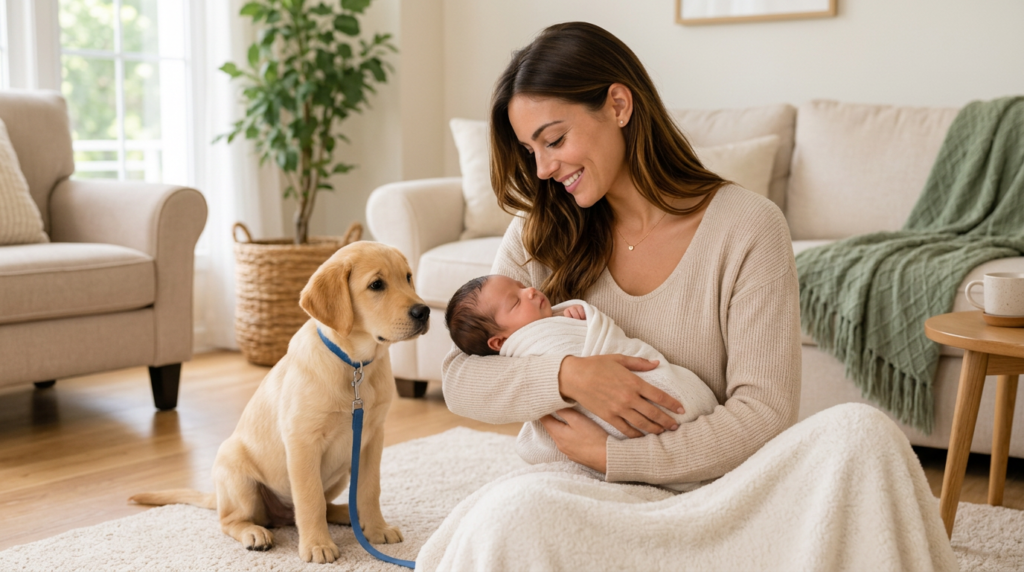
6. Let your dog sniff from a distance — feet or a blanket, not face-to-face.
Curiosity is normal and doesn’t need to be discouraged, just aimed somewhere safe. Some vets go further and recommend no direct contact at all for the first several interactions — not even a lick. Either way, skip the nose-to-nose introduction for now; there’s no rush to get there today.
If you did the scent-introduction step beforehand — bringing home a blanket with the baby’s smell before the actual homecoming — this moment tends to go more smoothly, since the smell itself isn’t new anymore, only its source is.
7. Reward calm, and don’t force anything that isn’t calm yet.
Treat and praise your dog the moment they’re relaxed near the baby. If they seem overly excited, stiff, or anxious instead, that’s your cue to add distance and simply try again in an hour, not push through it. There’s no penalty for needing several short attempts spread across the first day rather than one successful introduction — most dogs settle into the new normal faster than the first hour alone would suggest.
What a rough first attempt actually means
If your dog seems agitated, avoidant, or overly fixated during this first try, that’s information, not failure. It usually just means today has been a lot — new smells, new sounds, a shift in your own energy and attention — and your dog needs more time and more distance than the sequence above assumed. Stepping back to a calmer environment, trying again after a nap or a walk, and lowering your own expectations for how fast this settles are all reasonable adjustments, not signs anything’s gone wrong.
The one rule that matters more than any of this
A calm first ten minutes doesn’t mean your dog has earned unsupervised time with your baby — not today, not next month, not ever, no matter how well today goes. Every major veterinary and behavior organization treats this as close to non-negotiable: never leave a dog and an infant alone together, even a dog you’ve had for years and trust completely. Most injuries to babies from family dogs happen in the first hours or days at home, and it’s rarely the dog anyone expected, whatever their history of trust. It’s the one rule with no exceptions.
If you want to know more: the ASPCA’s full guide to dogs and babies covers the homecoming moment in more depth, along with the weeks of preparation that come before it.
What actually matters: None of this has to be perfect, and there’s no version of today that locks in how your dog and baby will get along — or proves you don’t still need to supervise every interaction after. This is just the first ten minutes of a much longer relationship. Get through them calmly, keep watching closely after, and the rest has time to follow.
Before this moment even happens, it’s worth packing one thing that isn’t for the baby — it makes this whole homecoming easier.
We'd love to
hear from you.
Have a question, a tricky moment you're navigating, or a story worth sharing? This is a two-way street — we're always listening.
💌 Get in Touch