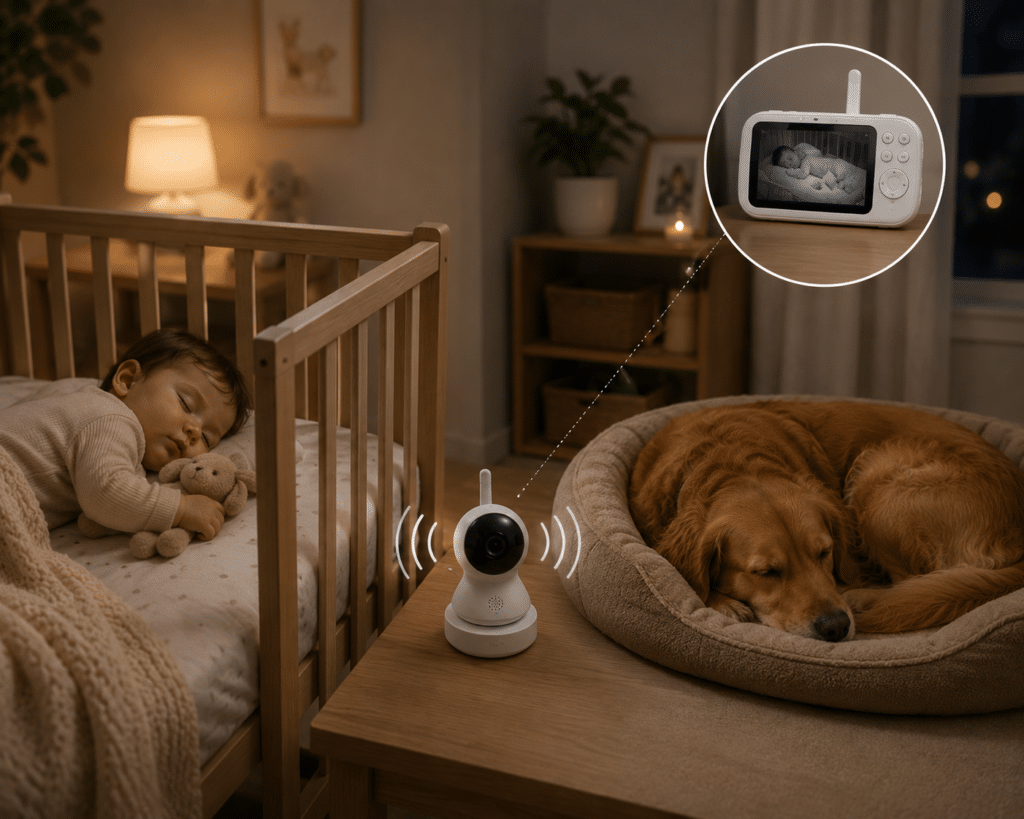
The official guidance here is simple, even if it’s not always practical in the moment.
Pediatricians advise against letting a dog lick a very young infant at all — not just the face.
A dog’s mouth carries a normal population of bacteria, some of which can occasionally cause illness in a newborn whose immune system is still developing. That’s why the official recommendation is to redirect licking altogether at this age, rather than drawing a line between “fine” and “not fine” spots on the body.
If you want to know more, the American Academy of Pediatrics advises against letting pets lick very young infants at all, since dog and cat mouths normally carry bacteria like Pasteurella: healthychildren.org.
Where the actual caution belongs
The areas of greatest concern are the baby’s face, particularly the mouth and any open skin, like a healing umbilical cord site — but the official guidance doesn’t stop there. Licking on hands or feet is lower risk than facial contact, simply because of what’s actually being touched and how likely that contact is to reach the baby’s own mouth afterward, but “lower risk” isn’t the same as “no guidance either way.”
A Little Support for Every Stage
Helpful checklists, guides, and resources to make each stage a little easier.
What actually reduces the risk
Most of the actual risk reduction here is simple: redirect licking calmly, without a dramatic reaction that might make your dog more curious about the behavior rather than less. Regular handwashing for the baby’s hands, the same general hygiene habit you’re likely already practicing, further reduces whatever residual risk remains from incidental contact.
If it happens anyway
A dog getting in a lick before you catch it isn’t a reason to panic or treat every interaction as risky. It’s a reason to gently manage where licking happens going forward, the same low-key way you’d manage any other minor safety detail during this stage — not a source of ongoing worry, just one small habit worth guiding.
As your baby gets older and their immune system matures, this becomes less of a specific concern, though redirecting licking remains a reasonable habit regardless of age, for hygiene reasons that apply to everyone in the house, not just infants.
Where this lands: the official guidance is to redirect licking altogether while your baby’s this young, face or hands. If it happens anyway, it’s not an emergency — just gently redirect and move on.
Thinking about where naps happen around the house generally? Here’s how to set up shared spaces safely, licking included.
And if the question isn’t about daytime naps but where your dog sleeps at night, here’s what actually needs to change, and what can stay exactly the same.