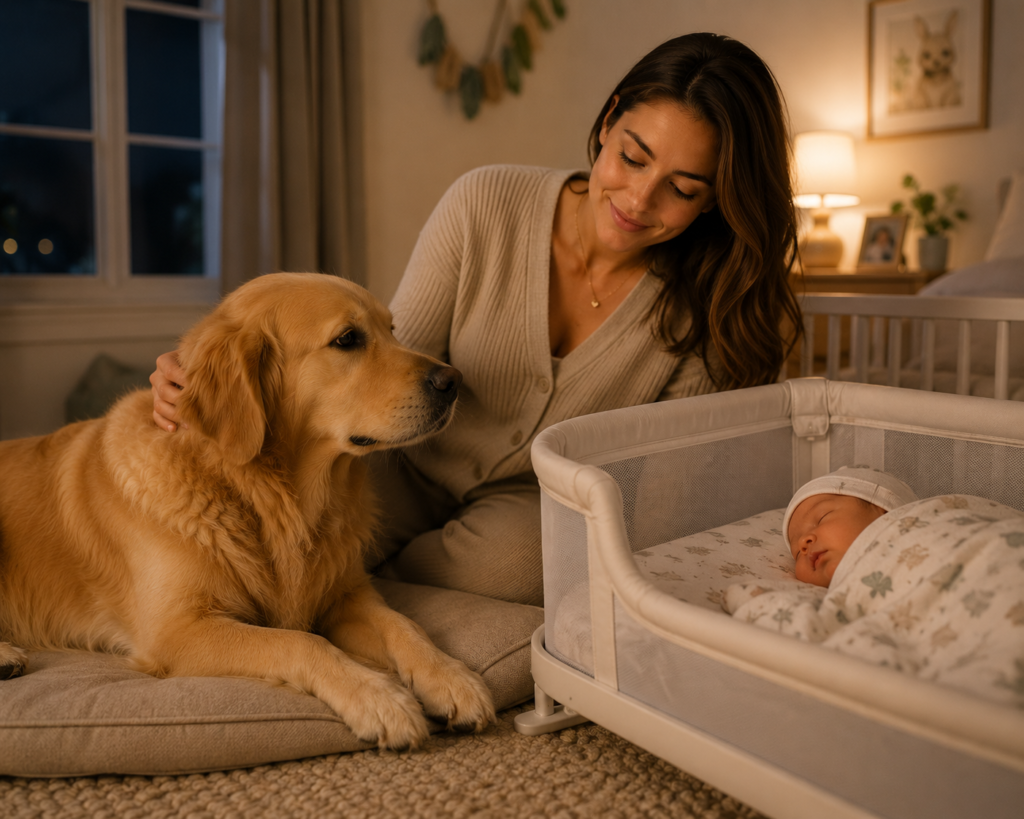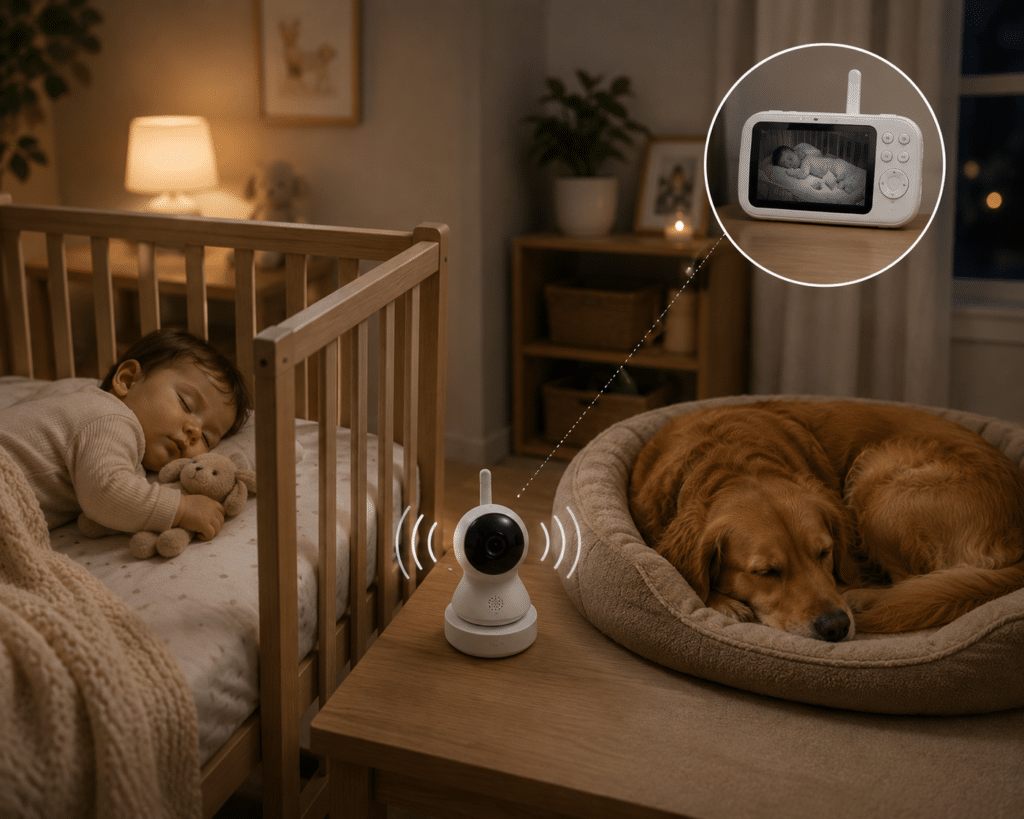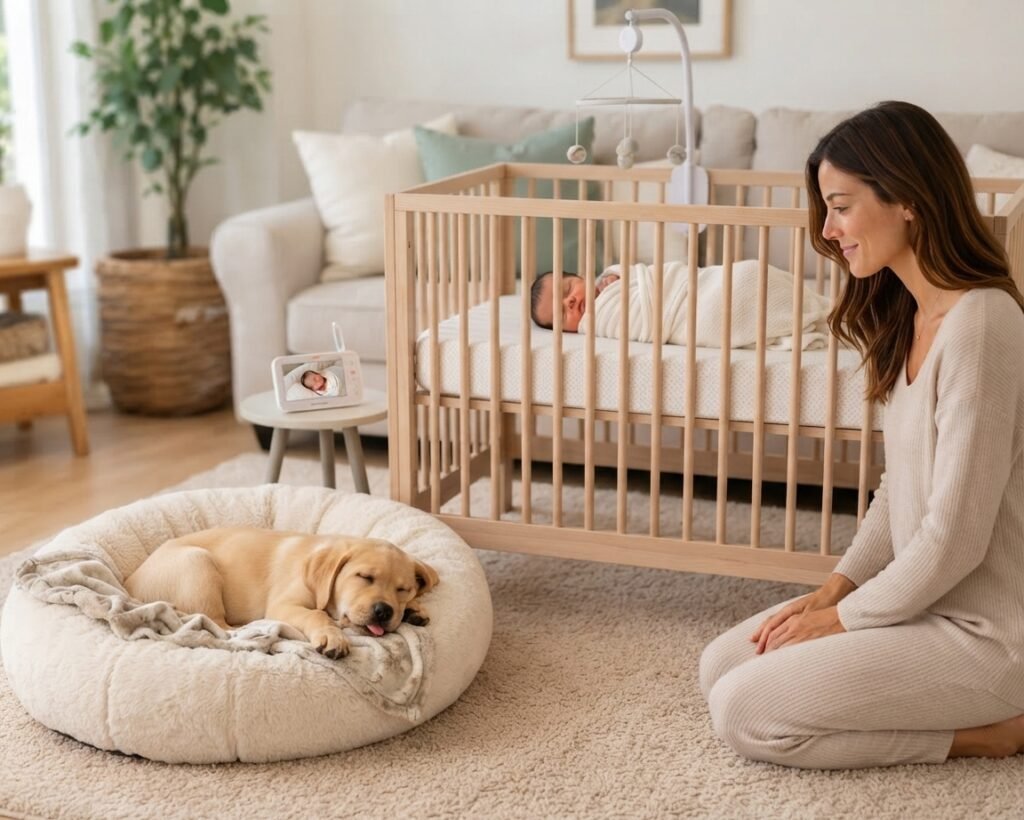
Nap time happens all over the house in the early weeks — not just in the nursery.
A little forethought about where and how makes shared spaces safer without requiring your dog to be banished from the room entirely.
Before the setup:
- This isn’t about excluding your dog from common areas. It’s about a few specific placement choices.
- Nothing here requires special equipment beyond what you likely already have.
- Supervision is still doing the real work here — this is about making supervision easier, not replacing it.
What’s in this guide
- Use an elevated or enclosed sleep surface
- Position the nap spot away from dog paths
- Keep a physical barrier nearby
- Use nap time as low-key bonding time
- Adjust based on your specific dog
1. Use an elevated or enclosed sleep surface in shared rooms.
A bassinet or playard, rather than a blanket directly on the floor, puts real physical distance between a napping baby and a dog walking through the room, without needing anyone to leave.
If you want to know more: the AAP’s own safe sleep guidelines back the same idea — a firm, approved bassinet or crib beats a blanket on the floor, dog or no dog: healthychildren.org.
2. Position the nap spot away from high-traffic dog paths.
If your dog has a regular route through the living room — to a water bowl, a favorite window spot — placing the nap area outside that path reduces the number of close passes happening while you’re not directly watching.
A Little Support for Every Stage
Helpful checklists, guides, and resources to make each stage a little easier.
3. Keep a physical barrier nearby, not just a mental one.
A portable gate or pen, easy to set up quickly, gives you a fast way to create separation in a shared space without needing a dedicated nursery every time a nap happens somewhere else in the house.
4. Use nap time as low-key bonding time, when you can.
Supervised, calm time with your dog nearby while the baby naps — not unsupervised proximity, just your own presence alongside both of them — reinforces that shared space is normal and calm, not a moment of exclusion for your dog.
5. Adjust based on your specific dog’s demonstrated behavior, not a generic rule.
A calm, low-key dog may need less physical separation than an excitable one. Let what you’ve actually observed guide how much structure a shared nap space needs, rather than applying the most cautious version regardless of your dog’s actual temperament.
Where this actually lands: shared spaces don’t need to become off-limits to your dog — an elevated sleep surface, thoughtful placement, and a barrier within easy reach cover most of what actually matters here.
Wondering about direct contact too, not just proximity? Here’s the honest answer on licking.
Wondering about nighttime specifically, not just daytime naps? Here’s what actually needs to change, and what can stay exactly the same.