Your child just noticed the dog wanted to be left alone, and let her be.
That’s empathy, right there, no lesson required — and it’s the small, ordinary moments like this one, repeated over years, that quietly shape how she reads people too.
The specific skill worth reinforcing
The specific skill worth reinforcing as kids get older is reading another creature’s needs from cues rather than words — recognizing that a pet who’s moved away wants space, or that a pet nudging a bowl is hungry, requires genuinely paying attention to signals instead of being told directly. This kind of observation-based empathy transfers surprisingly well to reading other people’s cues too, since it’s built on the same underlying skill of noticing what someone else (human or not) is communicating without words.
A Little Support for Every Stage
Helpful checklists, guides, and resources to make each stage a little easier.
How the opportunities shift with age
As kids move through different ages, the specific opportunities shift. A younger child learns basic cues — happy, scared, hungry. An older child can start noticing more nuanced signals — subtle stress, mild discomfort, the difference between wanting attention and wanting to be left alone — and can begin to connect a pet’s needs to genuine responsibility, not just observation.
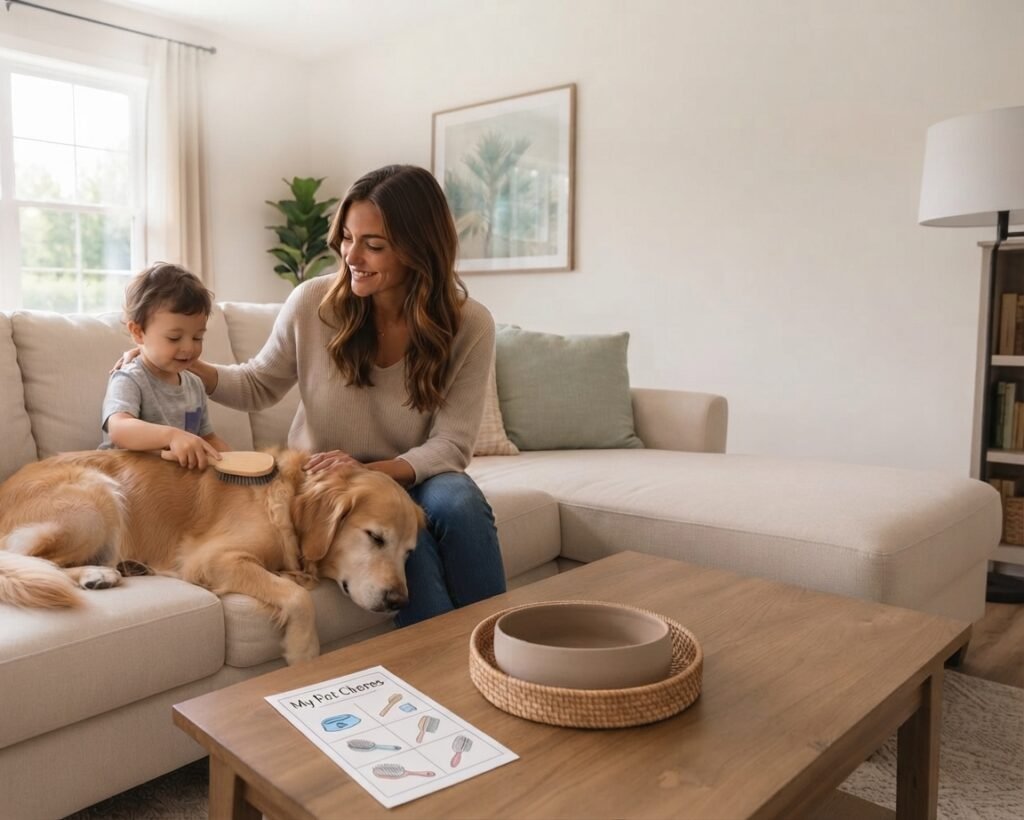
In practical terms: a child around 6 and under can come along on the walk, help pour food into the bowl under supervision, and do some gentle brushing — small acts that build the habit of noticing without any real independent responsibility yet. Somewhere around 7 to 12, that shifts toward actually owning a piece of it — handling a pet’s mealtime with only occasional reminders, helping with bathing and grooming, coming along to a vet visit and hearing what the vet is checking for and why.
The framing that actually matters
This works best when framed as noticing and responding, not as a chore to complete correctly. A child who’s praised for noticing the dog seems anxious, and asking what might help, is building something different than a child who’s just following a checklist of tasks — the former is the actual empathy-building piece, the latter is simply task completion.
None of this requires a formal teaching moment. It happens in the accumulation of ordinary days, noticing and responding to a pet’s needs alongside a parent who’s modeling the same thing themselves.
One research finding worth knowing: a large study of school-age kids found that simply having a pet in the house didn’t predict stronger empathy on its own — what mattered was how positively a child felt toward animals and how involved they were in caring for one. That lines up with the framing above: it’s the noticing and the caring, not the pet’s presence by itself, doing the actual work.
Source: a 2018 study on pet attitudes and youth socioemotional outcomes, published in Frontiers in Psychology.
Where this lands: pet care is genuinely one of the more effective, low-key ways kids build real empathy over time — not through a single conversation, but through years of small, repeated moments of noticing and responding to another creature’s needs.
Curious what this looks like once there’s more than one pet in the mix? here’s how caregiving responsibilities actually split across multiple kids and pets.
We'd love to
hear from you.
Have a question, a tricky moment you're navigating, or a story worth sharing? This is a two-way street — we're always listening.
💌 Get in Touch