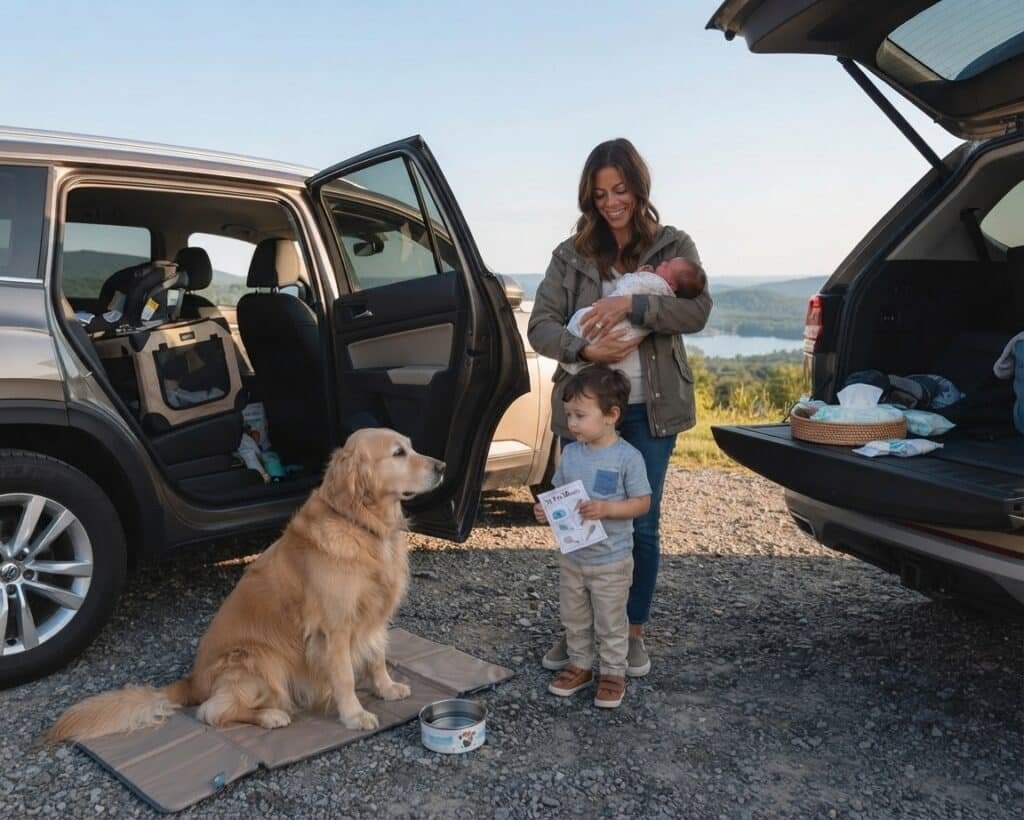
A family trip gets meaningfully more complicated once it includes both young kids and a dog.
A little structure up front makes the difference between a manageable trip and a genuinely stressful one.
Before the planning:
- This isn’t about avoiding travel with dogs and kids together. Plenty of families do this well.
- Nothing here requires a perfectly planned itinerary. Just a few categories worth thinking through ahead of time.
- The goal is realistic expectations and a bit of preparation, not a flawless trip.
What’s in this guide
- Decide honestly whether the dog comes or stays
- Build in more stops than you think you need
- Pack the dog’s familiar items
- Research dog policies at your destination
- Have a backup plan for a bad travel day
1. Decide honestly whether the dog comes or stays, per trip.
Not every trip needs to include your dog, and boarding or a trusted sitter for a specific trip isn’t a failure of commitment — it’s sometimes genuinely the better call, depending on the destination, the length of the trip, and how your specific dog handles travel and unfamiliar environments.
2. If they’re coming, build in more stops than you think you need.
A road trip with a dog and young kids benefits from more frequent breaks than either group alone would require — treating the trip’s pacing as the more conservative of the two sets of needs, rather than splitting the difference, tends to go more smoothly.
One rule worth building the whole schedule around: never leave the dog alone in the car at a stop, even for a “quick” bathroom break. On an 85-degree day, a car’s interior can climb past 100 degrees in about ten minutes and hit 120 within half an hour — and on a mild 70-degree day, it can still reach 90 inside. A stop only counts as a real stop if everyone, dog included, gets out together.
Temperature figures from the ASPCA’s guidance on pets and hot cars.
A Little Support for Every Stage
Helpful checklists, guides, and resources to make each stage a little easier.
3. Pack the dog’s familiar items, not just the practical ones.
A favorite blanket or toy, alongside the practical supplies, gives your dog something recognizable in an unfamiliar environment — the same comfort-through-familiarity principle that applies to bringing a toddler’s favorite stuffed animal applies here too.
4. Research dog policies at your actual destination, not just transportation.
Confirming dog-friendly accommodations, nearby vet options, and any local leash or space restrictions before you arrive avoids discovering a mismatch once you’re already there with everyone in tow.
5. Have a lower-key backup plan for a bad travel day.
Both young kids and dogs have off days during travel — a flexible itinerary that can absorb an unexpectedly rough day, rather than a tightly scheduled one, reduces the stress when (not if) something doesn’t go as smoothly as planned.
Where this actually lands: traveling with both kids and a dog asks for more built-in flexibility than either alone — extra stops, familiar comfort items, and destination research ahead of time cover most of what actually matters.
Managing multiple kids and dogs day-to-day, not just on the road? here’s how the logistics actually shift once there’s more than one of each.