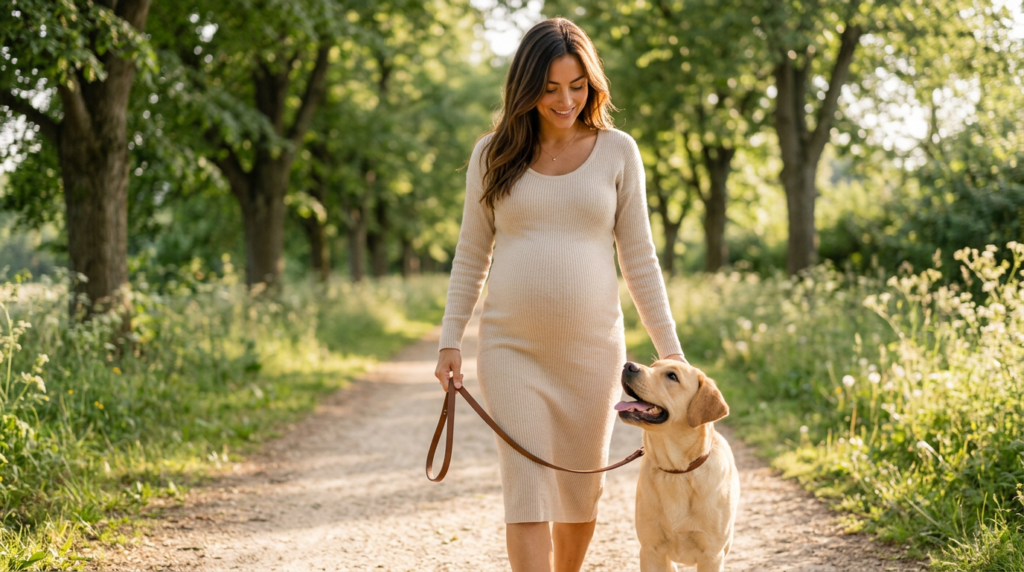
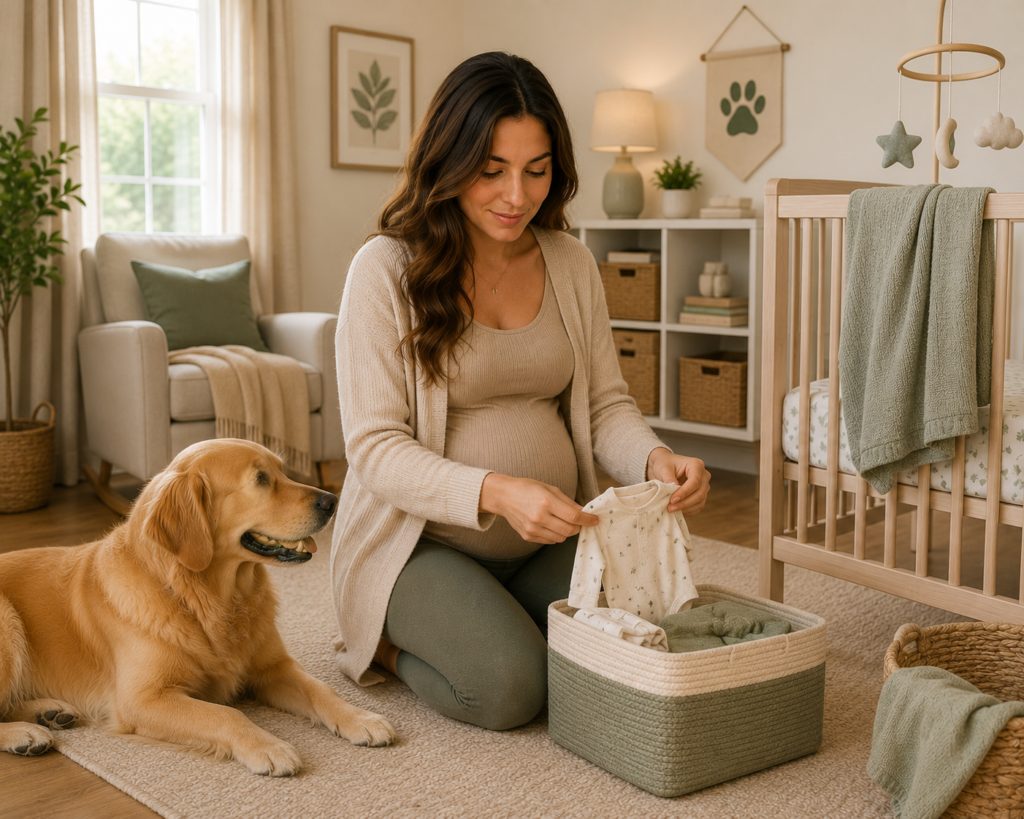
Your dog doesn’t need the nursery finished.
He just needs time to learn it’s not his room anymore — and that takes months, not days.
If you’re newly pregnant and staring at a space that’s about to become the baby’s, here’s the short version:
- Nothing here is about punishing your dog or making him feel replaced.
- The nursery doesn’t need to be finished before you start any of this.
- The first trimester is a fine time to rest. None of this needs to start yet.
Trainers and vets converge on the same shape: start in the second trimester, once early pregnancy fatigue has passed. That gives you four to five months before the baby arrives — enough time for changes to feel gradual instead of sudden.
Why the second trimester specifically, and not sooner
Starting too early doesn’t really cost you anything, but it doesn’t buy you much either — a dog’s memory of gradual training holds up fine over four to five months, so there’s no real advantage to cramming this into the first trimester on top of everything else you’re already adjusting to physically. Waiting until the second trimester also means you’re working with more energy and less nausea, which makes the training itself go more smoothly than it would if you pushed through it exhausted.
The 3 essentials
1. Set boundaries around the baby’s space, months before the baby.
If your dog currently naps on that floor or hops onto furniture that’ll become the crib’s spot, start closing the door or gating the room well before the due date. No separate nursery? The same principle applies to whatever space is becoming the baby’s — a crib corner, a designated crawl mat — just use an ex-pen or furniture line instead of a door. Dogs connect events that happen close together in time — set the boundary the week the baby comes home, and your dog may link the restriction to the baby rather than just learning the space is off-limits.
In practice, this usually looks like closing the door for short stretches at first — twenty minutes here, an hour there — while your dog has something engaging elsewhere in the house, then gradually extending how long the space stays off-limits. By the time the actual boundary needs to be permanent, it’s already a familiar, unremarkable part of the day rather than a sudden new rule.
2. Start reducing undivided attention now, gradually.
If your dog gets a 45-minute walk every morning and that won’t be possible with a newborn, shift the time and length of that walk now, in small steps. The goal isn’t less love for your dog — it’s making sure the drop in attention doesn’t happen the same week the baby arrives, where your dog has only one thing to blame it on.
A useful way to think about this: aim for the walk length and attention level you realistically expect to maintain once the baby’s here, and work backward from there over several weeks, rather than trying to preserve the current routine right up until the due date and then cutting it abruptly.
A Little Support for Every Stage
Helpful checklists, guides, and resources to make each stage a little easier.
3. Get the vet visit done early.
A full checkup catches anything health-related before your attention splits between a vet appointment and a newborn. It’s also the right moment to be honest about any anxiety, reactivity, or aggression your dog has shown — that conversation is far more useful with months to act on it than in a rushed visit right before the birth.
If your vet does flag something worth working on, this timing means you can actually follow through on a trainer’s recommendations before the household gets busier, rather than starting a behavior program at the exact moment you have the least bandwidth for it.
Worth doing if you have the time
4. Practice carrying “baby weight” around the house.
Fill a pillowcase with a few water bottles or a bag of rice so it carries roughly a newborn’s weight, and go about normal tasks while holding it. This won’t fully prepare your dog — a real baby moves, cries, and smells like nothing else — but it does get him used to your changed posture and movement ahead of time. Dogs are surprisingly attuned to how you carry yourself, and a sudden new way of moving through the house (one arm occupied, a different walking pace) can register as unfamiliar even without anything else changing.
5. Get your dog comfortable with the stroller.
A few practice walks beforehand, at an unhurried pace, remove one unfamiliar object from an already full homecoming day. Start in a low-distraction environment — your own driveway or a quiet stretch of sidewalk — before introducing it somewhere busier, so your dog’s first exposure to a large, wheeled object isn’t also their first exposure to a crowded park.
6. Play baby sounds before there’s a baby making them.
Play recordings at low volume during calm moments — mealtime, a chew toy, a quiet evening — and raise the volume gradually over a few weeks. Newborn crying in particular is a sound most dogs have simply never encountered, high-pitched and insistent in a way that’s genuinely unlike anything else in a typical household, which is exactly why a gradual introduction matters more here than it might for other new sounds.
A common mistake worth avoiding
The most frequent misstep isn’t skipping any single item on this list — it’s doing several of them all at once in the final weeks before the due date, once the nursery is finally taking shape and the reality of the timeline sets in. Bundling multiple changes into a short window recreates exactly the sudden-shift problem this whole approach is designed to avoid. If you’re behind on this list, it’s better to pick the two or three items that matter most (the boundary-setting and the vet visit) and do those well, rather than rushing through all six in the last month.
[lp_checklist_optin pdf_url=”https://lullapaw.com/wp-content/uploads/2026/07/lullapaw_nursery_prep_checklist.pdf”]
Where this actually lands: The 3 essentials are the ones that matter most — do those, and you’ve covered the real risks. Everything else is a bonus if you have the energy for it. By the time the nursery’s actually ready, your dog will already be a few steps ahead of it.
If a physical boundary is part of your plan, here’s which type of baby gate actually holds up to a determined dog.
We'd love to
hear from you.
Have a question, a tricky moment you're navigating, or a story worth sharing? This is a two-way street — we're always listening.
💌 Get in Touch