You don’t need a second gadget to ease your dog’s separation anxiety.
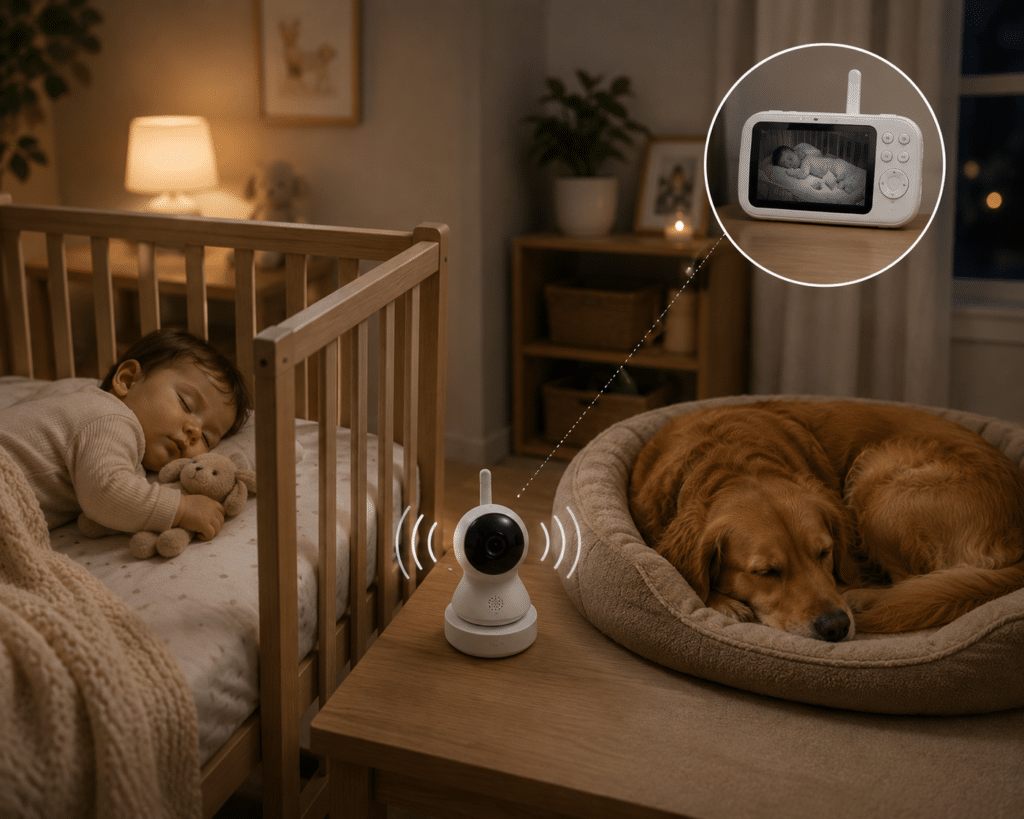
The baby monitor already on your registry does the same job.
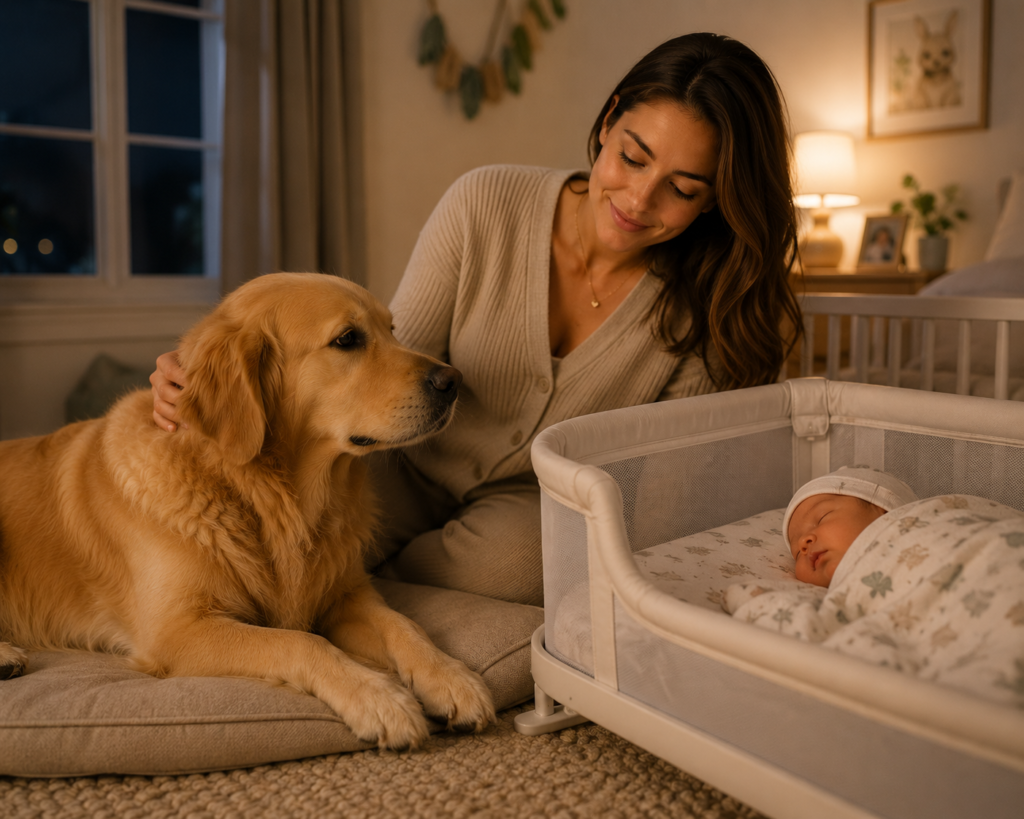
Your dog paces by the door every time you step into the nursery for a feeding. You’re about to add a baby monitor to the registry anyway.
Why the underlying mechanism actually works
The soothing effect isn’t just about noise in general — it’s specifically your voice, which a dog has learned to associate with your actual presence and attention over the course of their whole relationship with you. A generic sound wouldn’t do the same thing; it’s the specificity of hearing you, even remotely, that provides the reassurance. This is also why simply leaving a TV or radio on for background noise doesn’t accomplish the same thing a voice check-in does — it’s ambient, not directed at your dog specifically.
Who this actually helps
This matters most for a dog who already shows real signs of separation stress — pacing, whining, destructive behavior — not one who’s genuinely relaxed home alone already. Veterinary behaviorists estimate that somewhere between 20% and 40% of dogs show some degree of separation-related distress, so if this sounds like your dog, it’s common, not unusual. A dog without existing separation anxiety doesn’t need this kind of intervention; adding it anyway isn’t harmful, just unnecessary, since there’s no problem it’s actually solving for that dog.
If you want to know more: veterinary behavior researchers at the Institute for Environmental Research and Education have compiled the range of prevalence estimates across studies of dog separation anxiety.
A Little Support for Every Stage
Helpful checklists, guides, and resources to make each stage a little easier.
How to actually use it, practically
Point the monitor at whatever space your dog tends to settle in when you’re occupied elsewhere — their bed, a favorite spot near a window — rather than a general room shot that might not capture where they actually are. Check in with a calm, normal tone rather than an especially excited or soothing one; a dog registering unusual vocal patterns can sometimes read that as something being wrong, which works against the goal. A check-in every 20 to 30 minutes during a longer stretch — roughly the length of a feeding-and-settling cycle — is usually enough to keep an anxious dog from spiraling, without turning into so much back-and-forth that it becomes its own disruption. If your monitor’s app lets you adjust speaker volume remotely, keep it at a normal conversational level; too loud can startle a dog who’s already on edge.
What this doesn’t do
It’s worth being clear-eyed about what it doesn’t do: a camera and a voice check-in eases the moment, it doesn’t replace the underlying work of crate training or gradual alone-time practice. If your dog’s separation stress is significant — destructive behavior, self-injury, prolonged distress well beyond the separation itself — this is a supplementary comfort, not a substitute for addressing the anxiety directly with a trainer or behaviorist.
A version of this that works even without checking the monitor actively
Some two-way monitors support pre-recorded audio clips you can trigger without being actively present to speak live. A short recording of your own voice, played at intervals during a longer separation, can offer some of the same benefit for moments you genuinely can’t step away to check in personally — not a full substitute for live interaction, but a reasonable middle option worth knowing your specific monitor supports, if it does.
If a two-way monitor is already on your list for the nursery, you likely already own what you’d otherwise buy separately for this.
If your dog’s stress shows up more as barking every time the baby cries than pacing when you’re gone, here’s what’s actually happening, and what helps.
We'd love to
hear from you.
Have a question, a tricky moment you're navigating, or a story worth sharing? This is a two-way street — we're always listening.
💌 Get in Touch