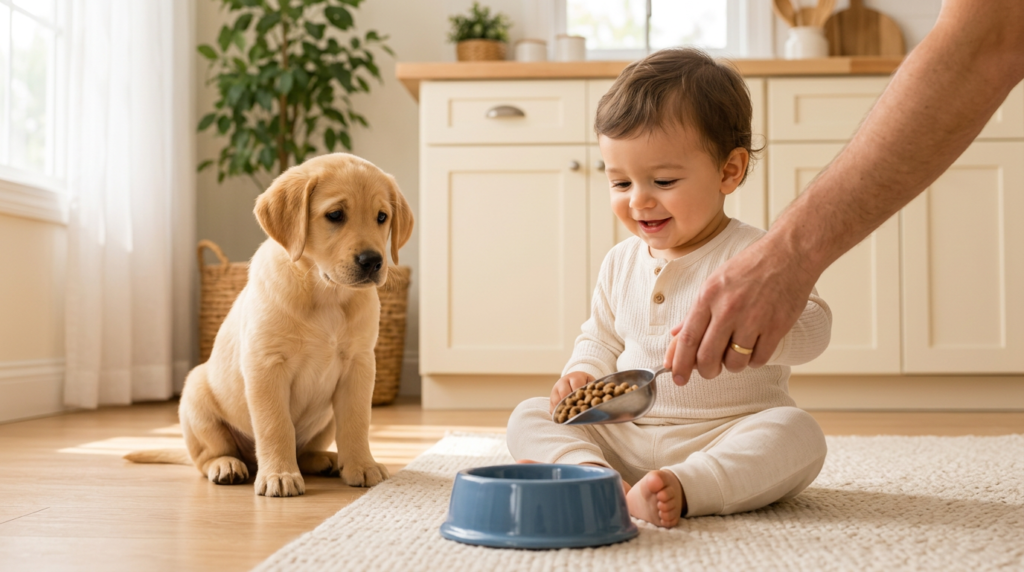
Your toddler wants to help at feeding time, scoop in hand, standing right next to an excited dog.
There’s no single age where a toddler becomes ready to help feed the dog.
Most three- and four-year-olds can already scoop, pour, and refill water on their own — it’s only the bowl itself that stays in your hands a little longer.
Why the bowl-down moment specifically carries risk
Even a well-behaved dog can get excited or protective the instant food actually appears, which is a different risk than the calm scooping and pouring earlier in the process. That part stays an adult’s job until somewhere between ages five and nine, when a child can take it on with an adult still nearby, especially the first several times. The anticipation right before food arrives is a genuinely different emotional state for a dog than the neutral moments of preparation before it — more dogs show some excitement or mild guarding right at that instant than at any other point in the routine.
Why age isn’t really the operative factor
The difference isn’t really about age at all — it’s about which specific moment carries risk. Brushing, filling water, and putting away toys don’t share the same food-guarding possibility that the actual bowl-down moment does, in any dog, regardless of how gentle they normally are. This reframing matters because it means the goal isn’t waiting for your child to hit a certain birthday — it’s understanding which specific tasks are safe at which stage, which can actually happen faster than a strict age-based rule would suggest.
What this looks like with a genuinely food-motivated dog
Some dogs are simply more intense about food than others, independent of training or temperament otherwise. If your dog gets notably worked up at feeding time — circling, whining, pushing toward the bowl — it’s reasonable to extend the adult-only window on the actual bowl placement longer than the typical five-to-nine range, and to keep your toddler further back during that specific moment even once they’re helping with everything else.
A Little Support for Every Stage
Helpful checklists, guides, and resources to make each stage a little easier.
Making the handoff feel like teamwork
Let your toddler do the parts that are genuinely theirs, and narrate the handoff as you take the last step — it reads as teamwork, not as being pushed aside. Something as simple as “you got it ready, now I’ll bring it to him” frames the adult’s role as the natural next step in a shared task, rather than your toddler being stopped from finishing something they started.
Signs your toddler might be ready for the next stage
Beyond a specific birthday, a few practical signs tend to matter more: whether your child can reliably follow a one-step instruction under mild excitement, whether they’ve shown patience waiting for a turn in other contexts, and whether your dog is generally calm and predictable at this moment specifically. A child who’s otherwise ready but has an unusually intense dog, or vice versa, might reasonably move at a different pace than the general five-to-nine range suggests.
What to do if your toddler tries to rush ahead
It’s common for an eager toddler to reach for the bowl before you’ve said it’s their turn, especially once they’ve been helping with the earlier steps for a while and feel confident. A calm, consistent redirect — “scooping and pouring is your job, the bowl is still mine” — repeated as many times as it takes, works better than treating it as a rule they’re breaking on purpose.
This fits into the same stretch as teaching a toddler to respect the dog’s space — feeding time is one of the moments that rule is built for.
We'd love to
hear from you.
Have a question, a tricky moment you're navigating, or a story worth sharing? This is a two-way street — we're always listening.
💌 Get in Touch