Most dog-and-toddler rules only go one direction.
A real rulebook works both ways — because your dog’s space matters here too, not just your toddler’s.
Before the list:
- This isn’t a list of restrictions on your toddler. Half of it is commitments the adults keep.
- Nothing here needs to be memorized perfectly on day one. It gets repeated into habit over months.
- One rule at the bottom matters more than the rest combined.
What’s in this guide
- The rules at a glance
- Rules your toddler is learning
- Commitments the adults keep
- The one rule that covers everyone
- What to do when a rule gets broken
The rules at a glance
For your toddler:
- Soft touch, not too much.
- Dog with a bone, leave him alone.
- Let the dog come to you.
- When the dog walks away, that means stop.
- The dog’s bed is only for the dog.
For the adults:
- A safe space for the dog, always open.
- Watch the dog’s signals, not just the toddler.
- Live by the same rules you’re teaching.
- Real one-on-one time for the dog.
For everyone: never alone together.
Want it on the fridge? The printable version, The Both-Of-You-Live-Here Rulebook, is in our Toddler resources.
Rules your toddler is learning.
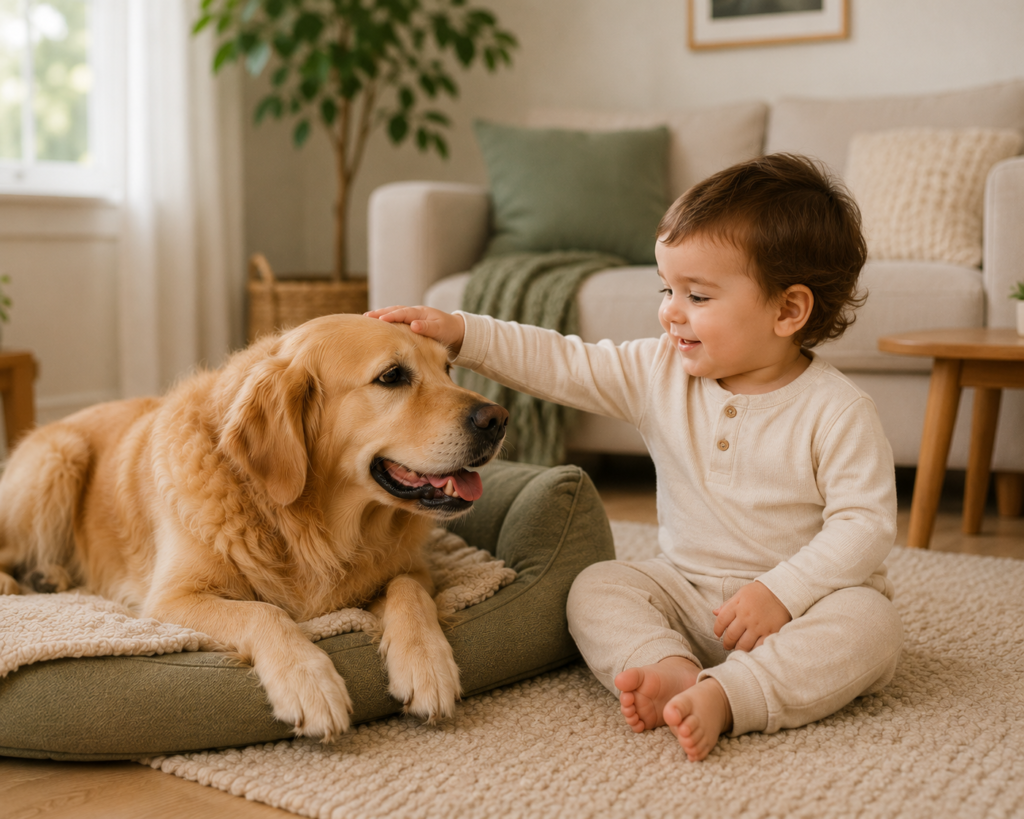
Soft touch, not too much. Gentle strokes on the back or shoulders, not the face, tail, or ears. This one is learned through the hands more than the ears, so it’s worth guiding your toddler’s hand the first many times.
Dog with a bone, leave him alone. The same goes for a dog with a toy, eating, or resting in their crate. This rule earns repeating more than any other on the list, since food and treasured things are where even gentle dogs can feel protective.
Let the dog come to you. The dog decides when to say hello. Modelling this yourself — waiting for the dog to approach, even as an adult — teaches it faster than explaining it ever could.
When the dog walks away, that means stop. A dog choosing distance is the end of that moment, not an invitation to follow. Expect this to take the longest to stick, because to a toddler a moving dog looks like a game of chase.
The dog’s bed is only for the dog. No climbing in, no reaching in, no “visiting.” It’s one of the easiest rules for a toddler to grasp, because it’s about a place rather than a behaviour.
The rules are the “what.” For the “how” — the way to actually teach them at one, two, and three — here’s the deeper guide to teaching a toddler to respect the dog’s space.
A Little Support for Every Stage
Helpful checklists, guides, and resources to make each stage a little easier.
Commitments the adults keep.
A genuine safe space, always available. A crate, a bed, or a room your dog can retreat to, which your toddler learns is off-limits, no exceptions. “Always available” means exactly that — not closed off during the busiest parts of the day, which is precisely when your dog needs it most.
Watch for the dog’s signals, not just your toddler’s behaviour. Flattened ears, a tucked tail, stiffening, or moving away are all worth stepping in for, before anything escalates. This is an adult responsibility for years to come; it isn’t something to hand off to your toddler, it’s a permanent part of how the household works. Here’s the fuller list of warning signs worth learning to recognize early.
Live by the same rules. If a rule doesn’t apply to the adults too — staying calm, respecting the dog’s space — a toddler won’t hold onto it either. Kids notice quickly when rules only apply to them.
Real one-on-one time for the dog, away from the busiest parts of the day, so the household’s energy isn’t the only thing they’re managing. This is easy to let slide once a toddler seems like less work, so it’s worth treating as a standing commitment rather than something that happens on its own.
The one rule that covers everyone.
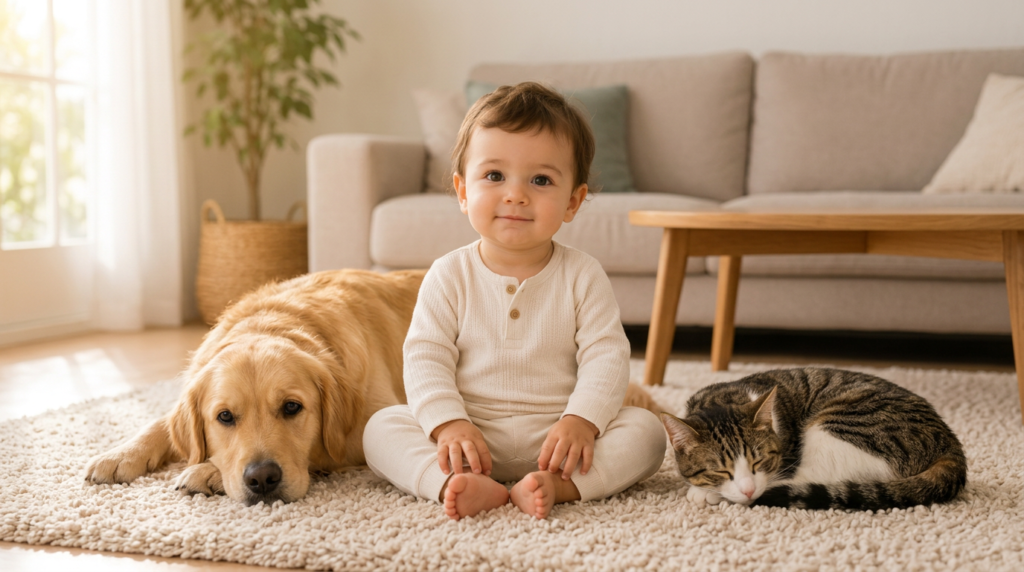
No unsupervised time together, ever, regardless of how well things have been going. This isn’t a rule that graduates away with good behaviour — it’s the one that doesn’t bend. Every other rule on this list builds toward more trust and less active management over time. This one stays exactly as firm five years in as it was on day one.
If you want to know more, the American Academy of Pediatrics is clear on this point: never leave a small child and a dog alone together, even the family dog: healthychildren.org.
What to do when a rule gets broken
It will happen, probably daily for a while, and that’s normal. Separate first and explain later: calmly move your toddler or let the dog leave, then use one short line — “the dog walked away, so we stop” — rather than a lecture in the moment. If your dog growled, don’t scold the growl; it’s your dog’s clearest way of asking for space, and it’s information for you. Then look at what set it up — a tired toddler, a hungry dog, a crowded room — and if the same rule keeps getting broken in the same spot, make it easier to keep, with a gate or a new place for the dog’s bed.
Where this actually lands: a real household rulebook protects your dog’s space as much as it protects your toddler — that’s what makes both sides of it stick.
Volume deserves the same attention as touch — teaching a gentle voice is worth doing alongside it.
And if your dog retreats to their safe space the moment things get loud, that’s exactly the response this rulebook is meant to support.