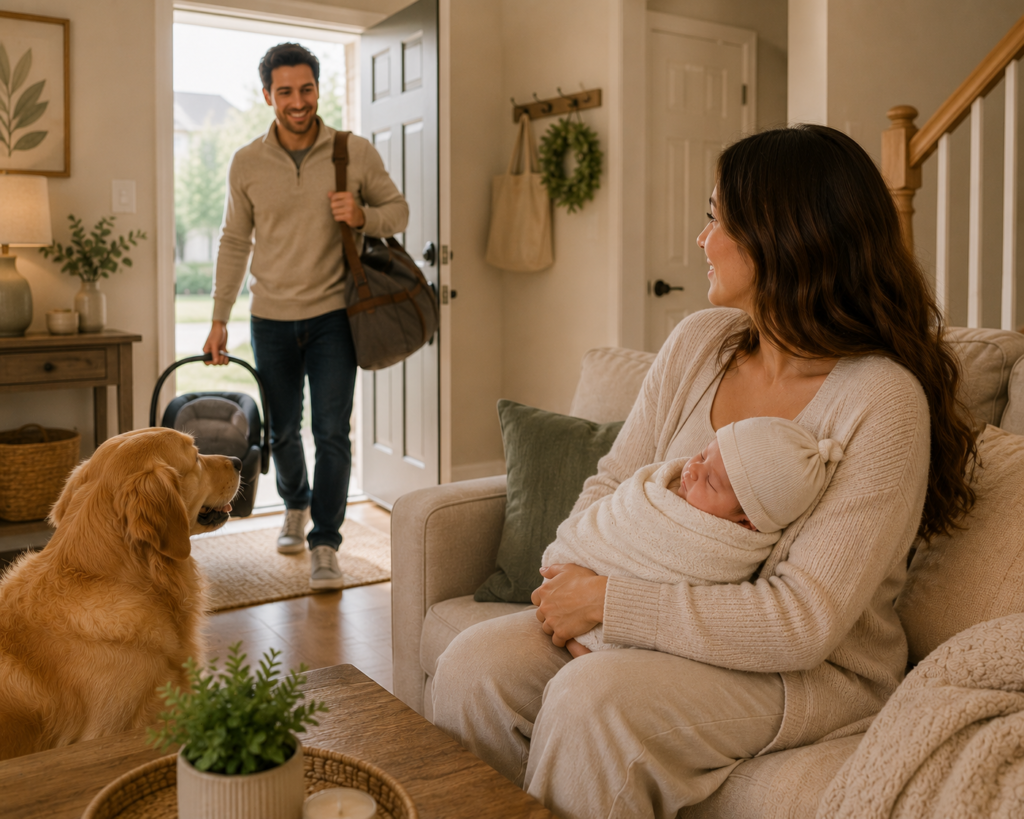
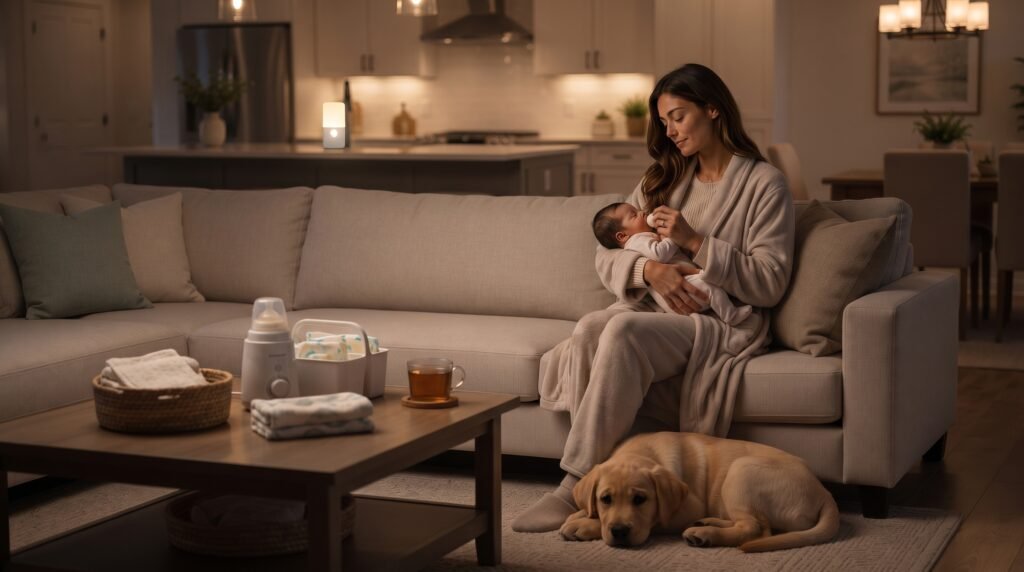
You don’t need anything fancy for the first night home with a dog in the house.
Mostly, you need lower expectations than a normal night — the first one is rarely smooth for anyone, pet included, and that’s not a sign anything’s gone wrong.
What actually helps
What actually helps is fairly simple: if your dog normally sleeps in your room, keeping that arrangement for the first night rather than changing it on top of everything else avoids adding one more disruption to an already disrupted night. If nighttime feedings mean lights and movement your dog isn’t used to, a brief, calm acknowledgment — a soft word, not an elaborate greeting — tends to help more than either ignoring them entirely or making a big deal of the disturbance.
A water bowl and access to their usual nighttime spot, checked before you settle in for the night yourself, means one less thing to manage if the night does get long. If the baby’s sleeping in a bassinet in your room, keep your dog out of reach of it overnight regardless of how much you trust them — a closed door, a baby gate, or a crate a few feet away all work; this is about safety, not about your dog’s temperament. Beyond that, there’s genuinely not much to prepare specifically for night one that isn’t already covered by the general homecoming groundwork — the exercise, the calm introduction, the retreat space — done in the days leading up to it.
A Little Support for Every Stage
Helpful checklists, guides, and resources to make each stage a little easier.
If your dog seems unsettled overnight
If your dog does seem unsettled overnight — pacing, whining, general restlessness — that’s a normal adjustment reaction to a genuinely disrupted routine, not a sign something’s gone wrong. It tends to ease within the first several nights as the new overnight rhythm becomes less novel.
If it’s specifically the crying that sets them off
Some dogs aren’t reacting to the general disruption — they’re reacting to the sound itself. If that’s what you’re seeing, a fast-track version of a standard desensitization approach can still help even now that the baby’s already home: play a recording of a baby crying at a low volume, well below whatever level actually bothers your dog, paired with a high-value treat or a bit of play, then stop before they get worked up. Repeat a few times a day at random times rather than a fixed schedule, and only raise the volume once the lower level stops getting a reaction. This can take anywhere from a few days to a couple of weeks depending on the dog — patience matters more than speed here.
Desensitization method adapted from Victoria Stilwell’s Positively.com guide to dogs and baby-crying sensitivity.
Where this lands: the first night doesn’t need a special plan beyond what you’ve already done to prepare for homecoming generally. Lower expectations for how smooth it’ll be, and a bit of patience, cover most of what actually happens.
Before you’re even at this point, it helps to know what to do in the first 10 minutes home — a calmer start tends to mean a calmer first night too.
We'd love to
hear from you.
Have a question, a tricky moment you're navigating, or a story worth sharing? This is a two-way street — we're always listening.
💌 Get in Touch