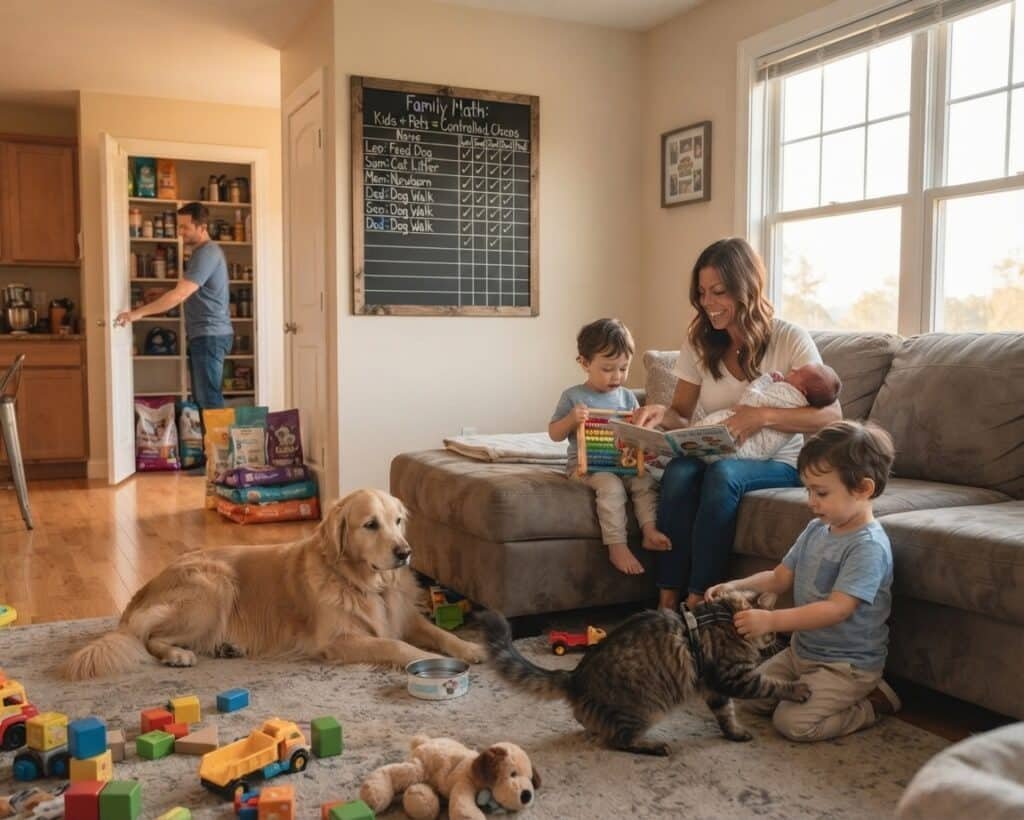
Two kids and two pets isn’t simply double the household of one kid and one pet.
The actual dynamics shift in ways worth planning for specifically, not just managing as they come up.
Before the specifics:
- This isn’t about having “too much” going on. Plenty of families manage this combination well.
- Nothing here requires a rigid system. Just a few deliberate habits that prevent things from feeling chaotic.
- The goal is noticing where attention naturally gets uneven, and correcting for it on purpose.
What’s in this guide
- Expect pairing, not just individual relationships
- Watch for whichever pet or kid is quietest
- Give each kid their own specific pet task
- Build in individual time
- Revisit the arrangement as kids get older
1. Expect pairing, not just individual relationships.
Kids and pets in a multi-everyone household don’t just have individual relationships with each other — they form pairings and patterns, like one kid gravitating toward one pet specifically. This is normal and doesn’t need to be forced into equal attention across every combination.
2. Watch for whichever pet or kid is quietest.
In a busier household, the pet or child who demands the least active attention is the one most likely to get overlooked, simply because louder needs tend to get addressed first. A regular, deliberate check-in with whoever’s quietest catches this before it becomes a real gap.
A Little Support for Every Stage
Helpful checklists, guides, and resources to make each stage a little easier.
3. Give each kid their own specific pet-related task.
Rather than a shared, vague responsibility, assigning each kid something distinctly theirs — one child handles morning feeding, another handles a specific pet’s walk — reduces both sibling competition over the “fun” tasks and confusion over who’s actually responsible for what.
Match the task to the age, not just the pet: a child 6 and under can handle pouring food into a bowl under supervision or coming along on a walk, while a child 7 to 12 can reasonably own an entire mealtime or take the lead on brushing and bath help. Two kids at two different ages almost never need identical jobs — matching each task to what that specific kid can actually follow through on beats splitting things evenly on paper.
Age guidance drawn from Animal Health Associates’ breakdown of age-appropriate pet responsibilities for kids.
4. Build in individual time, for pets and kids both.
One-on-one time between a specific kid and a specific pet, without every other family member present, matters more in a busier household precisely because it’s rarer and easier to lose track of amid the general group activity.
5. Revisit the arrangement as kids get older.
What worked when your kids were younger likely needs adjusting as they grow — an eight-year-old and a five-year-old can reasonably take on different levels of responsibility, and periodically updating who does what keeps the system matched to where everyone actually is now.
Where this actually lands: more kids and more pets means more combinations to actually pay attention to, not just more total work — a little deliberate structure around individual pairings and quiet needs keeps things from becoming genuinely uneven.
Thinking about adding one more pet into this mix? here’s what’s actually worth weighing before you do.
We'd love to
hear from you.
Have a question, a tricky moment you're navigating, or a story worth sharing? This is a two-way street — we're always listening.
💌 Get in Touch