
Most of what actually matters here is genuinely simple.
Here’s everything worth knowing, pulled into one place.
Before the checklist:
- None of this is a reason to rehome your cat. Every point here has a straightforward fix, not a “get rid of the cat” ending.
- Some of this repeats things worth restating, because they matter enough to say twice.
- The overall risk to a newborn from a healthy, supervised cat is genuinely low.
What’s in this guide
- Keep the crib itself cat-free
- Litter box hygiene continues after birth
- Supervise every interaction
- Know what cat scratch disease actually is
- Allergy fears aren’t a reason to rehome
- FIV can’t spread to humans
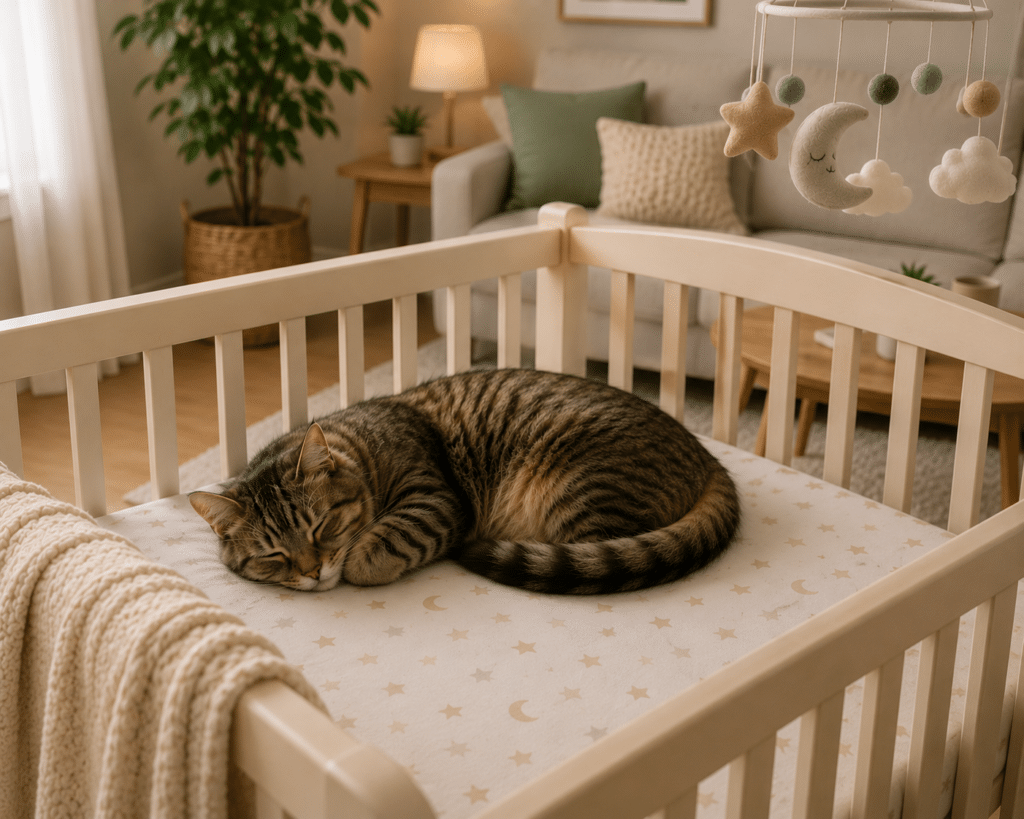
1. Keep the crib itself cat-free.
A crib tent with a structured top, plus a closed door or gate during sleep, handles this simply and permanently — we’ve covered the full reasoning (and busted the old “steals your breath” myth) in more depth already. Once this is set up correctly, it’s genuinely a one-time task rather than something requiring ongoing vigilance.
2. Litter box hygiene doesn’t stop once the baby’s born.
The same daily-cleaning, gloves-and-handwashing habit that mattered during pregnancy is worth keeping up afterward too — it’s a good routine regardless of the specific reason you started it. If a partner or family member took this task over during pregnancy specifically for toxoplasmosis reasons, it’s worth deciding together whether that arrangement continues postpartum or shifts back, rather than letting it default one way without discussing it.
3. Supervise every interaction, without exception.
Even a cat with a spotless history can scratch or startle unpredictably around a baby’s sudden movements or sounds. This isn’t about your specific cat’s temperament — it’s the one rule that doesn’t bend regardless of how well things are going. This includes seemingly low-risk moments, like a cat walking near a bouncer or play mat where the baby is resting — “nearby” and “supervised” aren’t quite the same thing.
A Little Support for Every Stage
Helpful checklists, guides, and resources to make each stage a little easier.
4. Know what cat scratch disease actually is.
It’s a real but usually mild bacterial infection passed through a scratch or bite, most common in children, and it typically resolves within a few months with antibiotics if it happens at all. Trimmed nails and prompt handwashing after a scratch are simple, practical ways to lower the odds further. Symptoms typically include swelling near the scratch site and mild fever, and it’s worth mentioning to a pediatrician if these appear after a known scratch, simply so it’s identified quickly rather than mistaken for something else.
5. Allergy fears aren’t a reason to rehome your cat.
A published study actually found the opposite of what most people assume — infants exposed to cats or dogs in their first year of life showed a lower rate of developing asthma and allergies later, not a higher one. Keeping your cat and only reconsidering if your child is later actually diagnosed with a pet allergy is a reasonable, evidence-backed approach. This finding surprises a lot of new parents specifically because the opposite assumption — that early pet exposure increases allergy risk — is so widely repeated as conventional wisdom, despite the actual research pointing the other way.
6. One reassurance worth knowing: FIV can’t spread to humans.
Sometimes called “cat AIDS,” feline immunodeficiency virus is a real condition in cats but isn’t transmissible to people — worth knowing so it doesn’t become one more thing to worry about unnecessarily. If your cat has FIV, normal supervised interactions with your baby don’t carry any special risk beyond the general handling guidance already covered above.
What this list deliberately doesn’t include
You won’t find anything here about restricting your cat’s general access to the house, banning them from furniture, or treating them as a categorical risk simply for being a cat in a home with an infant. Every genuine concern in this space has a specific, narrow fix — a crib tent, a hygiene habit, supervision during interactions — rather than a broad restriction on your cat’s normal life. That distinction is really the throughline across this entire list.
Where this actually lands: Nearly everything on this list has a simple, permanent fix — a crib tent, a hygiene habit, supervision, trimmed nails. None of it points toward rehoming, and the actual science on allergies argues for the opposite conclusion most people start with.
Nap time is where a lot of this plays out day to day — here’s how to set up shared spaces safely without banishing your cat from the room.
We'd love to
hear from you.
Have a question, a tricky moment you're navigating, or a story worth sharing? This is a two-way street — we're always listening.
💌 Get in Touch