
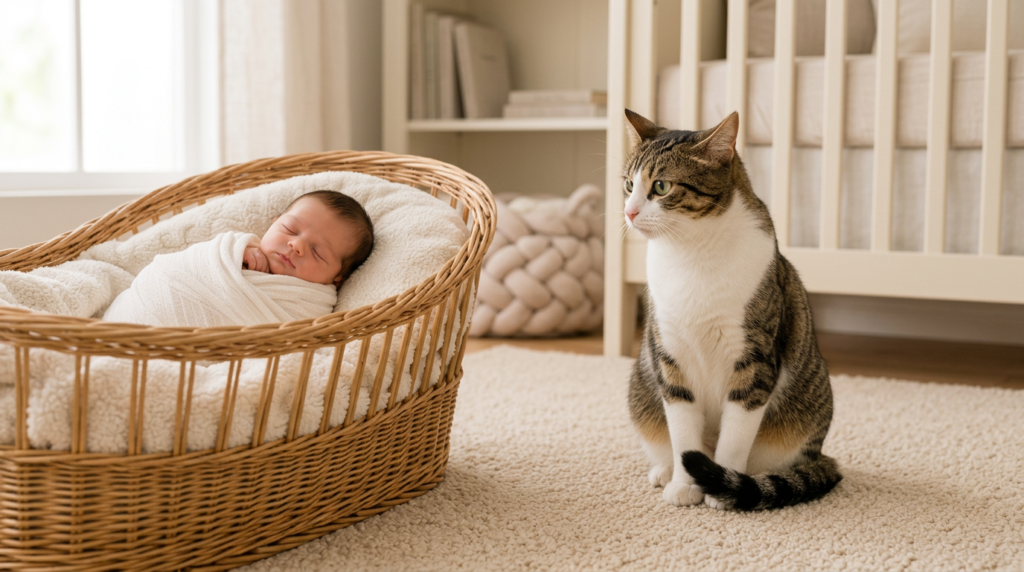
A cat rubbing against the bassinet looks like affection.
Sometimes it’s actually closer to anxiety — and knowing the difference is what lets you catch it early.
Cats are notoriously quiet about stress compared to dogs, which is exactly why the signs worth knowing tend to be subtle, easy to explain away, or easy to misread entirely.
Litter box and appetite changes, first
Avoiding the litter box, eating less, or eating unusually fast are some of the most common early signs of stress in cats — and also some of the most commonly caused by an actual medical issue instead. This is the one to rule out with a vet before treating it as purely behavioral, since stress and illness can produce nearly identical symptoms in a cat, and treating a medical issue as a behavioral one delays the care that actually helps.
Withdrawal that isn’t really about the baby
A cat spending more time under furniture or in another room isn’t necessarily upset with the baby specifically — it’s often just seeking out the predictability their routine no longer offers as reliably. The distinction matters because it changes what actually helps: it’s not about winning your cat’s trust back from the baby, it’s about restoring some sense of predictable routine elsewhere in their day.
The surprising one: too much interest can mean anxiety, not affection
A veterinary behaviorist’s observation worth knowing: intense, almost obsessive following or watching of the baby can actually be an anxiety response, not affection, especially if it starts feeling uncomfortable to watch. This is easy to misread as your cat bonding well, when it’s sometimes the opposite — a kind of hypervigilance rather than genuine curiosity or warmth. The tell is usually in the body language accompanying the watching: a relaxed, curious cat has a loose body and soft eyes, while an anxious one tends to hold themselves stiffly even while staring intently.
A Little Support for Every Stage
Helpful checklists, guides, and resources to make each stage a little easier.
Overgrooming and scratching in new places
Overgrooming or scratching in new places can both be a cat’s way of self-soothing under stress, distinct from normal grooming or scratching habits. A noticeable increase, especially somewhere new, is worth paying attention to rather than dismissing as a quirk. Overgrooming specifically can progress to visible bald patches or irritated skin if it continues unaddressed, which is one more reason it’s worth noticing early rather than after it’s become a more visible problem.
What actually helps, beyond just noticing
Keeping feeding times, play, and as much of the normal routine intact as possible does more for a stressed cat than any single fix — consistency is the thing cats regulate around most. A retreat space that’s genuinely theirs, and dedicated one-on-one time away from the baby, both reinforce that the routine hasn’t disappeared, just shifted. Even five or ten minutes of focused play at a consistent time each day can do real work here, since it’s not really about duration, it’s about your cat being able to predict that this specific good thing still happens.
Why cats show stress so differently from dogs
Part of why these signs are easy to miss is that cats evolved as both predator and prey, which favors masking vulnerability rather than displaying it openly — a stressed cat’s instinct isn’t to announce it the way a stressed dog might. This isn’t a flaw in your ability to read your own cat; it’s a genuine species difference worth knowing about, which is exactly why paying closer attention during a period of major household change pays off.
When it’s more than adjustment
If these signs are severe, sudden, or not easing over a few weeks despite a consistent routine, that’s worth a vet or behaviorist conversation rather than more waiting. Most of this settles with time — the exceptions are worth catching early, not late, and a vet visit to rule out a medical cause is always a reasonable first step if anything on this list feels more serious than typical adjustment.
Where this lands: a cat showing these signs isn’t rejecting the baby or failing to adjust — they’re a naturally quiet animal going through a genuinely large change. A predictable routine and a retreat space of their own do more for this than anything else on the list.
Speaking of a retreat space: here’s how to set up a real decompression zone that gives them somewhere to actually settle.
We'd love to
hear from you.
Have a question, a tricky moment you're navigating, or a story worth sharing? This is a two-way street — we're always listening.
💌 Get in Touch